|
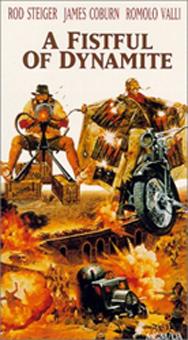
A FISTFUL OF DYNAMITE or DUCK, YOU SUCKER (1972) Directed by Sergio Leone
Starring James Coburn, Rod Steiger Music by Ennio Morricone
Rated PG Length 138 minutes
Summary Juan Miranda (Steiger), self-interested and disillusioned leader of a small group of bandits (made up of his family) fatefully encounters Sean, aka John, Mallory (Coburn), a mysterious remnant of the Irish Revolution - and a master of explosives, particularly dynamite.
Juan suggests that John join him in his quest to rob the Mesa Verde bank. John, haunted by a friend's doublecrossing in the Irish Rebellion, refuses. He eventually tricks Juan into participation in the ailing Mexican Revolution. At first Juan is furious, expressing his disdain for intellectuals who design revolutions and the poor who die in them. But as the two men's comradeship deepens, Juan becomes a major force in the Revolution. As the film progresses, the audience gradually learns of Mallory's tragic past and why his stake in the Mexican cause is so personal.
Review Perhaps one of the most unfortunate aspects of modern cinema is the underestimation of the so-called "spaghetti" Western. Too often the connotation prematurely waves away any discussion of these films' merit, let alone their seriousness. A Fistful of Dynamite (entitled Duck,You Sucker outside of the U.S.) is not a Western in the strictest sense. Since it takes place during the Mexican revolution, it has been called a Zapata Western. (Don Siegel's Two Mules For Sister Sara takes place during Mexico's Maximilian Affair, but passes as a Western as well.)
Sergio Leone, Italian writer and director of the highest caliber, stands as a master of his craft, undiminished to this day. His Kurosawan storytelling, his mixing of campy mannerism and drama, and his scene patience are remarkable. From an era devoid of CGI, Leone's "Western" films marked unprecedented quality in that genre. Obviously unafraid to incorporate homage to predecessors and influences, Leone dealt in what I call the Samurai-In-Boots/With Guns Formula: showdowns, conflicts, loners embroiled in larger dramas, and gritty depictions of life's precariousness and inescapable violence.
Most famous for his "Man With No Name" trilogy (A Fistful of Dollars, For A Few Dollars More, and The Good, the Bad, and the Ugly), Leone orchestrated the perfect marriage of film imagery and musical score in the partnership of amazing composer Ennio Morricone. The lifelong duality has forever grafted the name of Morricone to Leone: the film and the music in each instance are one and the same. Like the human element in Leone's films, Morricone's unconventional (to say the least) compositions are manifestations of pure passion, impression, expression, and romance.
The consistent feeling of frontier limitlessness flows throughout the film: the now-lost fact of space and open geographical discovery and inhabitation, even in the early 1900s. Leone addresses the political nature of human interaction as he never has in other films, however, distinguishing Dynamite as a more didactic work rather than a take on universal motifs and mythic drama.
Leone is not shy about communicating alternative perspectives on the nature of government and revolution, and how revolutions become governments that are very rarely less despotic than the previous establishment. Nor does he romanticize revolutionary leaders into all-caring, dashing lights in a dark world. Hypocrisy and frailty, power and subjugation, rich and poor, privileged and deprived, bigotry, ulterior motives: Dynamite contains all these.
The basic Leone magic is the depiction of human comradeship. Distinctions of class, ethnicity, criminal or law-abiding, etc., eventually dissipate or at least diminish to a trivial pitch. Intimacy is not an unmanly condition and the heroes in Dynamite (and all of Leone's works) certainly come to love and respect each other deeply. This love and respect is primarily translated through the eyes: the dominant of Leone's two obsessions, the eyes and the mouth. Poignant moments bring the camera in for close - often very close - shots on the eyes or mouth. John's radiantly blue eyes (thanks to Coburn) and Juan's variably expressive brown eyes exchange unsaid knowledge and symbiosis, especially when there are surely no words to employ. Leone focuses on both the soul's windows (eyes) and desire's consuming, biting, ripping tool (the mouth), combining the human soul with the expressive body.
Immersed in heavy history, usually violent history, the characters eke out a parallel - and more important - drama: survival, connection, resolution of tortured pasts, and bonds for hopeful futures in the face of cyclical tragedy and loss.
review by D. Herrle 2/2003
|
|
[back to top] [home] |
|
© 2003 SubtleTea Productions All Rights Reserved |