 with boice-Terrel Allen: On the How to Be An
Adult album
with boice-Terrel Allen: On the How to Be An
Adult album|
David Herrle SubtleTea Interview - boice-Terrel Allen: On the How To Be An Adult album |
David
Herrle SubtleTea
Interview
with boice-Terrel Allen: On the How to Be An
Adult album
Visit his new site HERE. Listen to tracks from the album: "How to Be An Adult" "The Man Who Stole The Moon" "Pauper's Grave" "Now That You've Found Someone Else"
D: boice, you’re still a rattlin’ cat. With a few books under your belt, you’ve also excelled musically with your motley-vibed debut album, How To Be An Adult. Band can jam and you got pipes. I have favorite songs from the album, which is a sign of success. Tell us the story of this album, the musicians and collaboration process, your primary influences.
boice: I suppose the process began in February 2007. I had recently moved back to New York from Pittsburgh in October of 2006 and was serving time in retail. Without naming names, I was working as a cashier at a hipster clothing store that sold clothes, dishes and guitars. It was hell working there, not necessarily because of the store, but more because of where I was at in my life and where I wanted to be. I’d moved to New York to somehow make a step forward with my writing career. However, after five months I was stagnating. Stagnating and not sure what to do next in my life. But like a Springsteen song, salvation came in the shape of a guitar.
Let’s back up to 2006. Rght before Thanksgiving I’m on my half hour break and finished eating early, so to kill time I’m shopping around the store. I go down to the basement to the housewares section and see several long, big boxes clustered together on the floor. This catches my eye - it’s guitar kits. The ones with a knockoff Fender, amp, strap, etc. I was immediately thrilled because I was calculating the cost with my discount in my head. Barely over $100. Now, at the time I had no idea why a guitar kit would be so low-priced and sold in a clothing store. The strings buzzed when you played it and the action was so high you could slide your arm up to the elbow through it. Fortunately, I had no knowledge of this important information because I might not have bought it. As I contemplated my future as your new favorite pop darling, I was trying to decide, if I bought it, whether or not I should take guitar lessons or get one of those how-to buffoon guides. Believing I know myself pretty well, I went with guitar lessons because I liked the accountability factor.
Through Craigslist I found a guitar teacher - which finally brings us back to February 2007. My teacher, Alan Cohen, had a studio in his home. After two months of practicing countless chords and calloused fingertips, he gave me an assignment to write a song. Scary! I’d never written one before. So the following week, when a song was expected, I totally flaked out with some lameass excuse about concentrating on the new songs he gave me to practice. Alan: "Bullshit!" Since I usually love a challenge (and he was right), I spent the following week working on what became “It’s Not Enough”. Next session, Alan produced a demo of the song. I must say it was amazing hearing something that previously didn’t exist come to fruition. This first song (along with Alan’s encouragement) was the gateway drug. Over the course of a year or so, I wrote nearly 30 songs.
Although I liked the demos, when I decided to make an actual album, I knew I wanted a full-band-in-the-studio sound. This decision led me on a ragtag journey of asking everybody I know for recommendations. Initially, I’d planned to work with a Pittsburgh band to record the entire CD, but they broke up. Months of searching led me to the musicians (Wayne Batchelor on bass, Dave Sherman on keyboards, Howard Alper on drums) and the producer, Ben Rice. The actual recording of the album began in August 2008 and finished in March 2009. Fifteen 10-hour days spread out over this period, which was due to financial reasons - as I got the money to pay everyone. The experience as a whole was quite smooth. We recorded 18 songs in such a short time, which I owe to the producer and the musicians. Although I’d never recorded an album before, I did have a clear vision of the sound I wanted and the album completely represents what I heard in my head.
Regarding my musical tastes, the really do cover a wide area. I would say my obvious influences are solo Morrissey, the first decade or so of Elvis Costello, and the Beatles. I think these are the artists that someone listening to the album might think of. But there are influences that are more covert. For example, I didn’t play guitar on the album, the producer did, but for the solos I told him to think like Frank Zappa. Zappa is my favorite guitarist because he obviously has the technical ability but his solos tell a story. They have a clear arc and they’re highly melodic. You can hum most of his solos despite their dexterity. Dylan’s an influence lyrically because I put great importance in the words even though it’s usually the hooks people are attracted to first. I think of Dylan in story songs like “Pauper’s Grave”. Springsteen for this reason too. Kanye West is an indirect influence for his genius and for taking creative risks. I also love Bowie, Joni Mitchell, Prince. I was certainly thinking of Sign O’ the Times because you have a record that just piles on styles and genres like “The White Album” too.
D: The ghost track on the album is a cover of Madonna’s “Laugh To Keep From Crying.” At the risk of offending Madge, I think you improved it. Why did you choose this song? What do you think of Madonna’s legacy today – particularly in Lady Gaga?
boice: Madonna is another one of those indirect influences. She’s always in my head, not just as an icon, but primarily because of melody. Her songs are hooks on top of hooks of pure pop. As a songwriter, I like making songs that someone can hum on the first listen. At least that’s the intention. I also like the verses to be as strong in their melody as the chorus. As a fan of Madonna’s, I knew during the demo stage I wanted to cover one of her songs. But which song? There’s so much celebrity skin attached to her music that if I covered something like “Lucky Star” you would only think boice covering a Madonna track the entire three or four minutes. So I thought the way to avoid that was to go obscure. Way obscure. In the Internet age it’s pretty easy to find online, but it has never been commercially released. It was on Madonna’s demo tape, the one that got her first record deal. Another reason I chose it besides it being so catchy is lyrically. Madonna wrote this song (along with Stephen Bray) before she was famous and it’s about following her dreams despite the struggles - which I could relate too.
Thanks for saying I improved it! I like cover songs to do something different than the original but still keep the initial intent. The original was very Chrissie Hynde and the Pretenders. I came up with the arrangement to be more rock - kind of like "Emotional Rescue" Stones covering a Madonna song.
[On Gaga,] I start by saying I’m a huge admirer of [her]. Personally, I see very little connection between her and Madonna. When I think of Gaga, I veer more towards Bowie, who she has named as an influence. You’ve got the avant-garde theatricality grafted onto pop music after the fact, although you know they were thinking of image when they were tracking vocals in the studio. And her detractors haven’t done their homework. She never said she was original. On the contrary, she’s said she steals from everyone. Which ironically is what Bowie has always said. Plus Bowie had the same criticism heaped on him too, that he was all show or all surface. This really didn’t change for Bowie until the Let’s Dance album and the Serious Moonlight Tour where he played his music without characters. What I also love about Gaga is how polarizing she is. I love polarizing artists! People either love them or hate them. There’s no middle ground. People don’t debate Kate Perry, but you can get into a bar fight defending Kanye or Madonna.
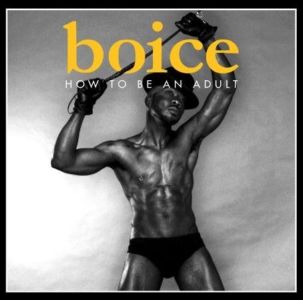
D: OK. You’re not wearing much on the front cover (shown above) and nothing in the liner-note photos. My initial thought (besides a jarring realization that I need to exercise more) was “Seal meets Mapplethorpe”: a combination of masculinity and flamboyance (toned muscles, a pierced nipple, black briefs, gloves, a riding crop). Bothering to sculpt the body shows serious care and respect for it. Your thoughts on body image, on exhibitionism, on sexiness? Is your fitness an art?
boice: “Seal meets Mapplethorpe.” I love that! I don’t think of fitness as an art. Maybe vanity (smile). Actually, I think of fitness as a metaphor for any goal in your life: yu get out whatever you put in. I like the equation of knowing that if I exercise, yoga, vitamins, eat right, etc., it will produce desired results. Or if I decide, as in the past, to write three pages a day for three months, I’ll have a first draft of a book. When you look at it that way you don’t have to depend on moods or inspiration, things that are fickle and will not serve you with any kind of consistency.
In regards to the CD, the photography and essentially any promotional pictures are another avenue of expression for me - an artistic expression. So, the intention is the same whether it’s a photo, a book or a song. The goal is to strive for greatness, something iconic, hopefully. And what I like particularly about photography is the creative relation that forms between the subject and the photographer. It’s completely in the moment what happens and can change from the initial concept. I was inspired by the beefcake muscle magazines from the 1950s and 1960s. At the shoot, however, the photographer (Jo Lance) suggested the look you described while the interior photo was the direct influence of my concept.
D: The How To Be An Adult title is curious, and the album has a recurring “boy” theme. (I can’t help but think of U2’s Boy.) “Those Itchy Boys/they don’t know what/they want,” “That’s the sound of boys/falling in love,” “I’m not like/other boys,” “A boy of twelve -/-Whose fate was sown/When mother flipped a trick/On a couch with a louse,” “He was a good boy/He was the baby.” I sense confusion about maturation (maybe sexual identity?) and fatherless roots: “How to be an adult/It isn’t easy when you’ve/never had the practice” and
I see others who’ve
got fathers…
To swing a bat
Who’ll show me that
Wish I could teach myself
But when you’re ten
You miss the ball
Just like you miss the man
Tell us about the boy and the adult. (And what/who are Itchy Boys?)
boice: It wasn’t until I was putting together the sequence of the album that the themes really stood out for me, which wasn’t intentional. I never said I was going to make a concept album. As I was pouring over the lyrics I was trying to decide what songs work best together, either lyrically or sound-wise. I ended up going with the ways songs sounded around and next to each other to create a mood and maybe tell a story that way. Going from power-pop to alt-pop, soul-folk to the Anthology of American Folk Music and dance and a Chet Baker-style standard. Wherever the album started wasn’t how it ended.
Thematically, yes you caught the boy/man references, which arrived quite organically. I think the theme were born out of the period they were written in. A few things: my on again/off again, troubling relationship with my deadbeat dad was recently off again - and still is - so I was expressing myself through the lyrics. If I’d been writing a book, it surely would come out through my fiction. Also, I was personally questioning what makes an adult an adult. Are you an adult because you pay your own bills? Is it where you’re at in your career? What is it? Is it your level of responsibility? Is it contentment? I don’t know - think there are many answers. The best answer I came up with personally was that adults are happy with the decisions they make for themselves.
Let me tell you what an Itchy Boy is. This is the definitive definition: an Itchy Boy is someone who can’t decide what they want in regards to relationships. Itchy Boys run hot and cold. Emotionally jumping from one feeling to another. Saying one thing but doing the exact opposite. And like Girl Power, Itchy Boys is a state of mind, so there are plenty of Itchy Girls out there breaking hearts. And for the record, you should know that I’m not an Itchy Boy.
D: In Cicero’s “The Dream of Scipio” Africanus explains that humans are deaf to the music of the spheres due to its omnipresence, just as those who live by the Nile don’t notice its noise. (As Poe’s “The Purloined Letter” shows, an important letter is best hidden in plain sight.) Is music the fundamental thing, the basis of all art? Coltrane played music as praise, as prayer, as passionate quest. Is there – at the risk of deserving groans – a Music Supreme? Please say something coherent in response to my gobbledygook.
boice: I don’t know if music is necessarily the basis of all art, but I do think that music can infiltrate and unite in ways that other art forms can’t. It’s always exciting to me to be in an arena of nearly 20,000 people singing one artist’s song despite each person getting something different from it.
D: boice, you strike me as a positive thinker who acts on and yields crops from his hope. Pascal teaches that “there is enough light for those who desire only to see, and enough darkness for those of a contrary disposition.” And Magritte says, “We mustn’t fear daylight just because it almost always illuminates a miserable world.” While there is much evidence for what Admiral Kurtz called “the horror! the horror!” in Conrad’s Heart of Darkness, G.K. Chesterton reminds us, “That the brutal forces always besiege and often capture the citadel does not prove that they are the citadel.” Your thoughts?
boice: I am a positive thinker - although you might not assume that from my lyrics. Without getting all metaphysical, although I’d love to,I really do believe we create our own reality. For example, we all know someone who bad things always “happen” to them or people who are consistently "lucky." I personally don’t believe I would have released a single book or album if I thought it was impossible. You sabotage yourself before you even start a project if you’re thinking: Who’d want to read my book? It’s so hard to get published. Nobody buys music anymore. This is an awful environment to start anything, it’s like you’re cursing yourself. Why wait for someone else to bring you down when you can beat them to the punch. I don’t say any of this flippantly or as if I never have doubtful days, but my natural inclination has always been one of optimism, so even in the times when I’m not so sure of myself I still persevere. But I still believe this is a proclivity I have to practice everyday.
D: Any new writing projects in flux or in the vault?
boice: Oh, David, I wish I could tell you I had several finished manuscripts in their tenth draft and my only dilemma was in deciding which book to publish next. I have the ideas, but nothing that excites me so much I need to start immediately. There’s an idea for a memoir and also for a novel-in-stories. The music seems to be my main focus right now and I still get to write, because there’s certainly a connection between my prose and my lyrics. I don’t think my lyrics would have been as strong if it weren’t for many years of writing fiction. I just feel fortune that I’m finally exploring my true passion in music and to be more than just a listener or a fan. I’m sure I’ll write more books.
Visit his new site HERE. Listen to tracks from the album: "How to Be An Adult" "The Man Who Stole The Moon" "Pauper's Grave" "Now That You've Found Someone Else"
|
[back to top] [home] |
|
© 2010 SubtleTea Productions All Rights Reserved |