|
D.
Herrle Tea Interviews - Collin Kelley |
|

|
Welcome
to the Tea Interviews.
I
devised this feature to edify fellow artists and to share that
edification with you readers/participants. I've seldom met an
artist, particularly a writer, who didn't tend to gab or spill opinions
or offer musings on his/her own work and worldview. Therefore I'm
tapping into this common tendency.
(Most
of the questions are tailored toward the featured interviewee.) |
Tea
Interview  with
Collin Kelley
with
Collin Kelley
D: Firstly, you've just published
your first poetry collection, Better To Travel. How do you feel?
Still floating an inch or so above the ground? Share some words on your writing
past (origin, encouragements, decisions, etc.).
I still can't believe I've published a book...it's an out of body
experience. Even holding the book in my hand is strange. It's been slowly
starting to sink in as people tell me they have read it or ordered it. I have
been writing since I was a child. I am a voracious reader thanks to my parents. They started reading to me when I was young and by the time I was in
kindergarten I was already reading on a very high level...like Nancy Drew and
Hardy Boys mysteries at age five or six. My mother would often have to check out
the books I wanted to read at the library because the librarian refused to let
me take them on my own. I distinctly remember reading "taboo" books by
Judy Blume even before I was in middle school. My parents were good enough to
allow this because they knew then that I had already decided that my life would
revolve around reading and writing. I went to work as a reporter for a
local paper when I was 15 and that started my journalism career. Today, I'm the
managing editor for an arts and entertainment
publication called Atlanta Intown. Journalism has always been in my
blood. I wanted to know everything that was going on in the world. I still do.
D: I've noticed you respectfully credit (and have been compared to) Anne
Sexton. Please share why Sexton is such an influence.
I found Anne Sexton thanks to Kate Bush and Peter Gabriel. I have
been a fan of Kate Bush for more than 20 years and she did that duet with
Gabriel on his So album in 1986. On that same album is Gabriel's song
"Mercy Street" which is based on Sexton's life. That song moved me so
much and I had no idea who Sexton was. I dove right in and bought Sexton's
complete poems and it turned me upside down. The woman absolutely just laid
herself bare in every poem and I thought she was the most gutsy, ballsy writer I
had ever read. Sexton led me to Plath, Adrienne Rich, Sharon Olds and all the
other confessional poets. I think Olds is our modern Sexton....unafraid to just
put it all out there no matter the consequence. I started writing my own poetry around 1987 or 88 and it was all shit. I didn't write something I was
proud of until about 1992. Everything I wrote prior, I put into the sink and
burned. I am very self-critical of my work, I agonize over it. I read later that
Sexton did this as well. Continually rewriting and reorganizing her work before
publication. Then she would agonize again before a reading. I know that feeling.
But then she would get up onstage at her readings and open her mouth in that
deep, smoky voice and just galvanize the room. I can only hope to be as good as
her one day. I have one poem in the book that references Anne ("Night
Working"). It's my tip of the hat for all her inspiration.
D: You perform along with a band called the Jennifer Perry Combo. What type
of music does the band usually play? What is your role with the band?
Please share whatever you wish in this regard (how you met, etc.). Ever consider
recording a collaborative album?
I met Jennifer Perry about five years ago after one of her gigs.
We started chatting and discovered that we had a mutual love for jazz divas like
Julie London and Annie Ross. We've been friends ever since, supporting each
other's careers. She and the band were nominated for a Grammy a couple of years
for best jazz song. They are just a very tight band, and Jennifer is a master at interpreting jazz. For the Better To Travel readings we are doing
classics like "Cry Me A River," "Fever," "To Hell With
Love," and "Black Coffee." We are also throwing in some Kate Bush
and Annie Lennox to mix it up a bit. We sat down with the poems from the book
and married the songs to the poems. It's going to be a very interesting and
experimental time for both of us. And yes, we have talked about working together
on a spoken word and music CD. We'll see how the gigs go in September.
D: You dedicate your book to a woman, Christeen Snell, who provided important
aid in realizing its publication. Who is she? Please share the
situation with us.
Christeen Snell is the director of the Fayette County Public
Library in Fayetteville, Georgia, which is my hometown. It's about 25 miles
south of Atlanta. We met at the library and became fast friends. She's a poetry
lover as well and she has the amazing voice. So, I started writing spoken word
pieces for us to perform. We did a couple of them called "Two Voices"
and "Poems For Conquering Venus." We went around to coffee houses, and
other places, on the radio, wherever we could. We had a blast. Some of those
poems are in Better To Travel. She encouraged me to get a book together
and I finally relented. She deserved the dedication more than anyone, if for
nothing else than kicking my ass and making me get about the business of putting
Better To Travel together.
D: Your favorite writers and books? Why?
Sexton, Olds, Don DeLillo, Margaret Atwood, Toni Morrison, Truman
Capote, Michael Ondaatje, Alice Walker, John Irving, Michael Cunningham and the
brilliant Jeannette Winterson (she's an English feminist-lesbian writer). I love
them all simply because they write difficult, moving, involving
"literature." You don't take a book like DeLillo's Underworld
to the beach for light reading. I absolutely must be challenged by what I
read. I want to be able to read it over and over and find new things every time.
Winterson's Written on the Body is one of the finest pieces of
literature written in the 20th century. It is up there with anything Woolf ever
wrote. Atwood's novels and poetry hit me just like Sexton did. Atwood published
a collection of poetry called Morning In the Burned House a few years ago
and it made me feel just like I did when I first read Sexton. They both write so
clearly and movingly about how life effects them. Many poets hide it all under
metaphors and conceits and I want to be able to read the poem and know just
exactly what is being said in no uncertain terms. That's what I strive for in my
own work.
D: Here's a vat of worms for you (grin).
William Faulkner said that "no writing will be
too successful without some conception of God. Sartre has denied God. I think
Camus will get better, but I think that Sartre will never be better."
What is your hunch or belief in this regard? Also, for instance, our last
interviewee made the interesting statement that he doubted he could be a
creative being if he hadn't been created. Thoughts on this?
I am not a religious person. I am spiritual and I do believe that
there is some larger force at work in the world, but I cannot believe that some
omnipresent God is watching over us. If that is the case, I'm not sure I ever
want to meet him especially after the things that have happened on this planet
in the last century. I know it may be a bit infantile, but it seems to me a God
who would allow the genocide, starvation and mass destruction such as Sept. 11
to repeatedly happen is no God I want to have anything to do with. If he's up
there, then he's abandoned this planet. The performance artist Laurie Anderson
(another source of inspiration for me) said in one of her pieces after Sept.11,
"if this is the work of an angry God, then I want to look into his angry
face." I think that sums it up for me.
That said, I do tend to use religious imagery in my writing (especially in
"Repentance"). The Bible is an incredible piece of writing, whether
you believe it or not. A book that can instill so much doubt, fear, joy, and
contradiction is something everyone must read. It's open to many
interpretations, obviously, and there are so many fantastical things that one
can't help being somehow inspired by them. The resurrection of Christ, the
casting out of the Devil, Lot's wife turning to a pillar of salt. Is it true? I
don't know. But it's brilliant writing.
D: Back to your new book,
Better To Travel. How did this work take shape? Did it
coalesce as your trip transpired, or was it a retrospective rendering
after you returned to the States?
BTT was written over a 10 year period. Some of the
poems were written before I went to Europe, but was dreaming of going
there. I went to London and Paris for the first time in 1995 and it
was a revelation to me. I always had this idea of what Europe would be
like in my mind, and the reality exceeded my expectations, which is
rare. A friend of mine had been dreaming of going to London forever
and had this Victorian fantasyland built up her mind and she actually
hated London when she finally got there. Detested it. I love it. I
love Paris, too. They are big and loud and dirty and oozing history
out of every crack. I'm a city boy anyway. Drop me in any big city and
I'm in my element. The main parts of BTT coalesced during and after
that first trip to Europe. I was at the end of an affair and needed
desperately to escape. When the offer to go to Europe presented
itself, I didn't even think twice. I actually fell in love with
someone else on that trip, but that wasn't meant to be either. So I'm
actually writing about two different people in BTT, but it sounds like
one person. That's because I seem to fall for the same type and I love
the same way. I invest way too much every time. The majority of the
poems in BTT are from 1995, 96 and 97. I was in a writing frenzy then,
or as Anne Sexton would have said, "I was on fire to write."
There were demons to be exorcised.
D: The cover of BTT features a lovely photo of a snow-dressed tree.
Please tell us why you chose this image, about the photographer, and the
location of the tree.
The photo is by a man named Ian Britton. He runs a photo company
out of the UK and he loves that tree. It's in Northumbria in the north of
England. He's photographed it in every season, but the one of it covered and
surrounded by snow is just haunting. I had a completely different idea for the
cover before I saw that photo, but I knew I had to have it for the book. BTT is
full of dark, wintry images and this tree seemed to be the words made real.
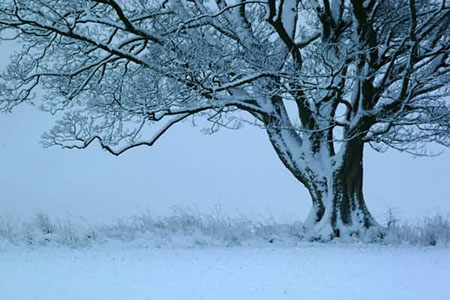
photo
by Ian Britton
D: The poetic narrator deviates from his obsession and pain and slow healing
in a few instances in BTT. "The Gift (For Diana)" is an example.
Shortly after I read the piece I realized it was for Princess Diana, mourning
her sudden death. Diana struck me as a redirected symbol of the shattered love
that seems to have inspired the book. Though you never met the woman you write:
"But I am you/We all are in some way/Living and dying in a light/less
luminous/hidden in plain sight". Care to share why Diana impressed
you so?
My feelings for Diana are deep rooted. I know many people think
that outpouring of grief in 1997 was just mass hysteria and is now a bit corny,
but I actually went into a deep mourning period for her and for myself. Diana
was a touchstone for me, one of those crystalline clear memories from childhood.
I had an enormous crush on her when I was a kid, I thought she was the most
beautiful thing I had ever seen and she was from England, which seemed like this
mystical place to me at the time. I had been reading the Narnia chronicles just
before all the media frenzy about her marriage to Prince Charles started up. So
here was a princess from England! It was all just amazing to me. I remember so
clearly getting up at 4 a.m. that summer in 1981 to watch her get married. I fell in love with London that day, was
overwhelmed by all those images. I knew I would have to get there eventually.
And so I followed her life from then on. She had been in the papers so much
before her death because of the charity auction for her dresses and her affair with Dodi Fayed. Then she was just gone, so suddenly and
horribly. I just couldn't get my head around it. Me and my best friend sat on
the phone together until five a.m. listening to them say over and over that she
was dead and I just could not accept it. I know many people think she was
mentally ill, but I think she didn't know how to live any other way after all
the pressure that had been heaped upon her. When she did that interview after
breaking up with Charles, I thought every word out of her mouth was truth. She
was being a confessional poet at that moment. Laying herself bare for the world
to judge. When you put yourself out there like that you have to be prepared for the backlash. Love is like that as well.
Like Diana, I have yet to get the balance right.
D: I'm quite fixated
on mortality and how the human foreknowledge of its fact plays with our
worldviews, art, and mental health. Better To Travel doesn't seem to
address mortal death, though it refers to the corporeal following a
"disembodied" manifestation of your person into the future (which can
be regarded as death in reverse, so to speak). What are your thoughts on
mortality? Are you hinting at a duality of spirit and body in your poetry?
If I had to follow an organized religion it would probably be
Buddhism. I believe in reincarnation and I believe I have lived other lives
before this one. I don't know if we come back to learn new lessons or if just
chose to return, but I truly believe it happens. I have had meditative
experiences, dreams, glimpses of those other lives. I do believe the body we
travel in is just a vessel, that when we die the "real" part of us
transcends to another level. I am not afraid to die, I am actually looking forward to it in a
strange way. It's the common denominator for us all, the greatest adventure we
will ever take. I can't believe that we just go around once and that's it. What
a waste that would be. There are so many sights unseen, and I think it may
take more than one life to see them all.
D: Please share a bit about your play, The Dark Horse, which won the
Deep South Writer's Award for Best Play in 1994 (theme, inspiration, details on
performance, etc.).
The Dark Horse was written in 1992 after I dreamed the
entire plot. I got up the morning after the dream and wrote the play in about
three or four hours. It's a long one act set in the 1920s about the famous,
reclusive artist named Jessica Hardwick. She lives on a remote island and this
young man and his mother come in search of her after he is challenged by his
professor at college. This sets up a tug of war between the mother and Jessica
over the fate of the boy. The title refers to a dream the boy keeps having a
giant black horse, and he finds out that the horse manifests itself on the
island and Jessica has been haunted by it for years. I don't know where the
dream came from, but it was one of the best dreams I've ever had. Not only did
it win the Deep South Award, but it also won the Georgia Theatre Award in 1997.
It's been produced locally a number of times.
D: (For personal kicks.) Are you familiar with Pink Floyd? I
consider them the most unique and important rock band so far. Thoughts?
Appreciation? Dislike?
I have a big appreciation for Pink Floyd, mainly because David
Gilmour is the man who discovered Kate Bush. She was a huge Floyd fan, and her
love of them encouraged me to dig deeper than "Another Brick In The
Wall." I think they are brilliant. I think their later work like Wish
You Were Here and The Division Bell were highly overlooked and
disregarded. Although I have to admit my favorite Floyd song is from The Wall...it's
"Run Like Hell". If I could be a rock star, that's the one song I
would like to belt.
D: A quite touching piece in your book, "Fall Comes", seems to
occur five months after the romantic fallout. Is this accurate? Splendid
(albeit sorrowful) words, excerpted: Yesterday,
I was too/introspective to write./All the words turned/inside, ran
circles./Goodnight, sweet you./This storm will be/over by morning./Five months
past,/again,/learning to crawl.
"Fall Comes" is a favorite of mine as well. I wrote
that the morning after this huge storm swept across the city. It was during one
of the hurricanes that hit the Gulf Coast and just kept on coming. I couldn't
sleep, the lights were out, and all those thoughts were running in my head. It
was five months after the end of the relationship and I still wasn't over it. I
woke up the next morning after the lights came back on and wrote that poem. It's
one of the few that did not get a lot of revision. The relationship had just
gutted me, it was the most intense I had ever had. It took years to get over it.
D: The narrator, by book's end, returns from his trip and finds he must
relearn language and behavior and even love. Is this a worthy
interpretation of the resolution?
Well, I think the narrator is a lot smarter and realistic about
life and love. There is a poem near the end called "Weather Storm"
where the narrator meets someone who is a mirror image of the person he just got
over and he is offered the chance to fall back into the same cycle, but he
chooses not to. And then in the final poem "Sights Unseen" he wants to
put the past behind him and explore a new future and other places. The book is
extremely dark, so I knew there had to be some light at the end of the tunnel so
to speak. The final section of the book is about getting over it and moving on.
There is always going to be fallout from that relationship, it will never
totally leave me, nor would I want it to. I have been in love again since then,
but I'm still looking for the right "someone."
D: Collin, I quite enjoyed your book. I also dig what you're doing
artistically overall. I've become acquainted with many interesting cats
through the site and I'm pleased to have "met" you. Of course, I
wish you blessings on your path. Any last words for the readers/fans?
Thank you so much for all your support. You and SubtleTea have
just been amazing. My last words are to the readers are to read everything you
can get your hands on. Take time out to read to your kids. Buy more books,
support literature and poetry.
click
here to visit Collin's site
Listen
to his internet radio program, Business
Of Words, at Leisure Talk Radio Network.
[back to
top]
[home]
|
© 2003
SubtleTea Productions All Rights Reserved |