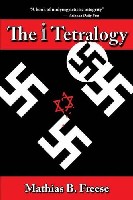
|
"The Little Man Danger and The i Tetralogy" - analysis and review by David Herrle |
published by Hats Off Books
$ 26.95
cover by Jordan Freese
This speculative, contextual review/essay is preliminary material for an expanded work on Nazism and metaphysics.
Look for expanded text in the future.
|
"There
is no safety for honest men but by believing all possible evil
of
evil men." - Edmund Burke The "Fascist" Fascination I
do not know if Jewish Holocaust films and books are preponderant over
works about other abominations in the last two centuries, but the topic is
certainly more familiar to most folks. Despite Communists' superior
mass murder, Nazi crimes seem much more fascinating and unfathomable.
Why? Why is Hitler more popularly despised than Stalin or Mao or Pol
Pot or other elitist thugs in relatively recent history?
(Charlemagne had 4,000 people decapitated in a single day.) Why is the
perverted swastika as commonly recognized as the yellow smiley face?
Sheer body count should not determine positive or negative greatness. Method, style, efficiency, indifference, and motive determine the weight of outrage, revulsion, and residual fascination. In fact, mass killings (by human design or nature) tend to cancel lasting outrage out, as if the magnitude is too immediate and unimaginable to retain. (Consider how quickly 2005's Asian tsunami grief faded despite continued aid programs that go on behind the scenes. 150,000+ people being wiped out in mere minutes is too swift and big to hold.) Premeditated, systematic abuse and slaughter wins prolonged attention. And though the Soviets excelled at premeditated, systematic abuse and slaughter, the award of Atrocity of the Last Century always goes to the Hitler regime. As George Victor writes in Hitler: The Pathology of Evil: "Hitler's rival in destruction, Joseph Stalin, had even more people killed...But what happened in the Soviet Union was less of a shock, for Russia had a history of government terror and cruelty to minorities. With a gentler history, called the land of poets and thinkers, Germany was known for its enlightenment and liberalism."
Perhaps the Nazis just shined brighter and with more gusto.
"The administrative mass killings of the Nazi era constitute something new
in the rich history of human violence," wrote Dr. Fredric Wertham.
He stressed that though "no single deed or event of this period is
entirely new," that "the total process is new."
Mathias Freese, author of The i Tetralogy, considers the
Jewish Holocaust to be "the single most important human event in
world history." Could he be right?
I
don't mean to diminish or absolve any non-Nazi atrocities.
However, in this piece I address a contemporary novel about the National
Socialist Workers Party scourge that happened to be one of the few
genuinely totalitarian systems in history (the others being under what I
call Big Communism umbrella). When one hears the words
"Nazi" or "Hitler," one thinks of
"Holocaust," "death camps," "gas chambers,"
"ovens," "human skin lampshades," "piles of
corpses," and so on. Sadly, the "forced-labor camp"
euphemism pops up when Communism is mentioned, downplaying the sadistic
death machine of the relatively guilty and the innocent alike. I
blame this on sociological/political kid gloves that handle Communist
atrocities - the same gloves that polish the reputation of pop-culture
T-shirt hero Che Guevera even though he was a murder-relishing snake.
The
term "holocaust" (from the Middle English for "burnt
offering" and Greek for "burnt whole"), used widely about
the Nazi nightmare only by the late 1950s, has become
inexorable from the Nazi stomping of Jews. I prefer to specify Shoah
or Jewish Holocaust when addressing the Nazi nightmare.
"Holocaust" is a word loosely used to describe countless acts of
inhumanity. The term belongs to a select few murder crimes.
The most recent event I can call holocaust is the 1994 mass slaughter of
Tutsis by crazed Hutus in Rwanda. That event, the gleeful murder of
a half-million to a million men, women, and children,
provides a key example of holocaust as I define it: An indifferent
liquidation of a people or peoples for the sake of liquidation.
Until relatively recently, slavery has been a historical (albeit horrible) norm, an open and usually acceptable aspect of society and even civilization. Totalitarian power is unique in its mastery over perception, its secret barbarism, and its complete dehumanization of inmate human beings. The inmate is isolated from time and space, damned to limbo. A slave at the very least has market value and labor purposes. A death camp victim has zero value and no purpose. He/she only breathes or labors in order to be controlled and denied both life and death until a whim or schedule flicks him from mortality. Why were there no notable revolt attempts in the death camps? Why did docile crowds often go knowingly to their grisly demise? Because identity and purpose were eradicated. Opposition needs will, but only a self can flex will - and, as Kierkegaard wrote, "a person who has no will is not a self." Unlike slaves or oppressed kinds or subjects of discrimination, death camp victims' very existence is effectively nullified. They are, to use a popular metaphor, living dead - or, perhaps more poetically, twice killed. Life itself is choked and erased; menstruation symbolically ceases.
Another misunderstanding about Nazis and Communists is focus on dissimilarities rather than commonalities. Somehow the "fascist" tag has become more prevalent and insulting among so-called activists and "socially aware" folks, and the fascist/"right-wing" nature of the Nazis seems to be blamed more than their basic engine of life-hatred and soul-murder. Nazism is a special phenomenon that eludes specific classification and is best described as erratic totalitarianism. Heeding the fascist tag (that applies differently to Mussolini's Italian regime), let us not forget that the National Socialist Workers Party was collectivist (the very term "fascist" stems from words referring to groups bound to central power), rebelled against the "old" republic and envied aristocracy, raised the group over the individual, and (like all Communist regimes) approved of an elitist Party and "transcendent" leader who embodied "the people's" will. I avoid referring to Nazis as fascists and rightists because I never want to diminish their kinship to Communist collectivism - and vice versa. These Statist monsters are from the same litter.
But, still, the Nazis win the day when it comes to contemplating or memorializing modern State cruelty. And though various regimes continue to persecute Christians, antisemitism (non-hyphenated thanks to Dennis Prager, who makes the important point that "anti-Semitism" applies to Jews being hated and not Semite Arabs) is resurfacing yet again.
Europe has a special affinity for periodic Jew abuse, for one. G.K. Chesterton called the Jews "the most famous scapegoat in European history." Hitler's rhetoric against Jewry didn't pop from a vacuum and suddenly seem sensible to the masses. It stemmed from and capitalized on the ancient cycle of antisemitism, the Pharoahs, the Visigoths, the collective grudges and fears of post-barbarian Europe, the military and conversion glory of Charlemagne (one of Hitler's models), the pogroms and exiles and fluctuating tolerance and clampdowns, the antisemitism of the Enlightenment (Volatire, etc.), the Dreyfus Affair, etc. Though Muslim Spain was a richly cultured and cooperative time for Jews, it was relatively short-lived. When the first Crusades started in 1096, there was repercussive action against Jewish "infidels," particularly in Germany. An army terrorized the Jewish areas of the Rhine district; Jews were slaughtered in Worms, Cologne, and many other cities until Henry IV tempered the bloodthirst and took measures to protect Jews. Of course, atrocities flared up again, despite Bernard of Clairvaux's imploration against such mistreatment and madness. Toledo Jews were mobbed in 1212; the Fourth Lateran Council included the canon that prohibited Jews from gaining office, hiring Christian servants, and from public appearance during Easter. Murders were conveniently blamed on Jews (as blood collection for Passover observance), vengeance was generally dealt (like the sheriff saying "Get me a nigger" to pay for an unsolved murder in Faulkner's Light In August) by mobs and raids. Despite his celebrated points, Martin Luther's invectives against "vermin" Jews enflamed later, religious rationalizations against the people. And let's not forget Hitler's musical and racial mentor: Richard Wagner, the talented Jew hater complete with belief in a conquering Aryan Jesus. [Suggested reading: Mark Twain's "Concerning the Jews" from Harper's Magazine, 1898.]
The Nazis didn't originate the armband and star idea. As far back 809 A.D. (the year Baghdad Caliph Haroun Al Raschid died), Muslim tolerance of Jews turned sour, and special badges distinguished Jew from Muslim. By circa 1215, Innocent III endorsed the yellow identification badges for Jews. This mark lasted for 600 years. Frederick II relocated Jews to ghettos and bashed Austria's Duke Frederick for passing laws protective and respectful of Jews. The Duke's measures ultimately failed, however. After Frederick II died, war broke out, and the notorious Judenbrenner (Jew burners) lashed out. About 1,000 Jews died after taking refuge from an angry mob in York Castle in England. Rather than be killed as "Christ killers," most opted for suicide, as their ancestors chose at Masada. Those who appealed to the mob's mercy were slaughtered. John of Capistrano waged great abuse against Jews, arriving in Cracow in 1454 and installing the infamous badge-identification. Spain ended up exploiting and abusing Jews, and Torquemada became Grand Inquisitor in 1483. Of course, there are the recurring pogroms and antisemitic movements in Germany throughout the 19th Century and the Russian-originated, forged Protocols of the Learned Elders of Zion to fan the flames all the way to the Final Solution. We needn't belabor the evidence.
Heed the words in the old Passover Haggadah: "In every generation there are those who rise against us to annihilate us."
Even without land disputes between Israelis and so-called Palestinians, there is much unchecked rage against Jews on the rise. And the current kowtowing to fanatic and violent Muslims is a sign of ready-made indifference (and even approval) to Jewish victims. This fact is another reason the Nazi nightmare is more fascinating. Historic wheels are turning in favor of the same recurrent evil that helped a resentful imp rocket to divine status.
I must repeat the words of Dostoyevsky - who racial occultist Alfred Rosenberg called "the incarnation of sickness" - on his trepidation over Germany's brewing consolidation and possible war-making in 1877 as pertinent to today's tension:
But God grant that I'm mistaken; God grant that the new storm cloud that is approaching simply disperses and that all my premonitions prove to be only my "fervid" fantasies - the fantasies of a man who understands nothing of politics.*
* (I must admit that I have problems with Dostoyevsky's ambivalent opinions on Jews. On one hand he wrote about brotherhood, rejected the "Christ-killer" accusation, equality, etc.; but he claimed that they controlled international politics and Europe through money, and associated them with "blind, carnivorous lust for personal material security" - what he considered anathema to Christian values. He never advocated persecution or eradication, however. In fact, he emphasized that he stood "for complete and conclusive equality of rights - because this is Christ's law, because this is a Christian principle." At least to that he was bound, unlike the Nazis.
All
Is Lawful/My Diagnosis
Perhaps the most common question that comes to mind when contemplating the Third Reich is: How could this happen? And that question contains subquestions: How could normal people go along with this? How could the German citizenry not have known about the camps? How could they have not revolted if they did know? What makes a doctor sworn to foster life become a practitioner of death? Did the majority of Germans knowingly surrender their identification for the guttersnipe Austrian? Sure, the National Socialists employed the usual appeals to the Common Good, challenge to envied financial interests, revived employment and profit sharing, government aid to the poor, blood pride, etc., but what worked to go those extra, insane steps into fanatical Thanatos worship? "Has the whole world, then, fallen under the spell of the evil eye of Leviathan?" asked Nazi-opponent Karl Barth. (Consider Stanley Milgram's famous blind-obedience experiment or Philip Zimbardo's Stanford Prison Experiment.) Psychoanalyst Franco Fornari wrote (as translated by Alenka Pfeifer): "Every one of us carries within himself silent, secret murders." Novelist Joseph Conrad said, "The belief in a supernatural source of evil is not necessary; men alone are quite capable of every wickedness."
From "The Psychology of Propaganda" by R. Money-Kyrle (1941):
"The people [at a Hitler/Goebbels rally] seemed gradually to lose their individuality and to become fused into a not very intelligent but intensely powerful monster, which was not quite sane and therefore capable of anything...The monster seemed to indulge in an orgy of self-pity...Self-pity gave place to hate; and the monster seemed on the point of becoming homicidal."
By the rally's climax, Thanatos, collective death wish, took over:
"'Germany must live; even if we must die for her...' The monster was ready, indeed anxious to immolate itself."
In Meno Meyjes' historical "what if" film about obscure starving artist Adolf Hitler, Max (starring John Cusack and Noah Taylor), an anecdote is shared during a family meal. Max Rothman mentions a woman who deliberately swallowed a tapeworm in order to lose weight. This, of course, repulses his father-in-law, but it struck me as analogous. Might people knowingly (however slightly) swallow a dangerous thing because that thing seems worth the risk to change a current affliction or depressing state? Erik Erikson wrote: "How deeply worried self-made man is in his need to feel safe in his self-made world can be seen from the deep inroad which an unconscious identification with the machine...has made on the Western concept of human nature in general." The Germans saw this new, promising, sleek and strong machine rise from Depression, insecurity, and dissolution - and accepted it as their savior. And technology, improvements of literal machines, came at the right time for the devils. Tetralogy's Gunther remembers the symbolic marriage of "twentieth century industrial machinery with the ancient hunt for the Jew."
Richard Rubenstein said Hitler "elicited from [the German people] something demonic, atavistic, and insane." The Nazis tapped into the volk's unresolved infantile desires, stimulated the "polymorphous perversity" (as Freud put it) of bygone infancy, and through this regressive liberation managed to surpass all rational (Überich, superego) limits. Hannah Arendt said totalitarianism bases itself on the concept "that everything is possible" (emphasis added), as Camus' play Caligula implies. (I'm reminded of a boasting Party song in Maoist China: "If our leaders hold the ladder/then we can scale the sky.") I think that this notion goes haywire if it is divorced from the idea of possibility through God and instead placed in the hands of whatever mighty men rule the moment. Perhaps Kierkegaardian despair* that pleads, "Get possibility, get possibility, possibility is the only salvation" is hyperextended by totalitarians seeking to replace God. Since despair is a result of apparent determinism, being locked in a closed machine, perhaps the God-replacer or anti-God makes a monumental and desperate grab at willful manipulation of existence.
This attitude exceeds any utopian faith in human perfection or dialectical materialists' belief in eventual economic concord. It literally erases ethics and morality and makes anything fair game. In his books, Dostoyevsky repeated his contention that if God doesn't exist (in humanity's hearts or actually) "nothing then would be immoral, everything would be lawful." So the Nazis launched from the "all is permissible" idea to the "everything is possible" idea. But possibility belonged to Hitler, no one else. The death camp inmates especially had no stake in possibility: For them all was determined, down to their choice to escape by deliberate death. O'Brien tells Winston in Orwell's 1984, "The rule of the Party is forever."
The
Nazis exercised the spirit of indifference
in their agents and minions. "It is human indifference that I
am after," said Freese in an interview. This indifference to
horrors is what alarmed Albert Camus so much about the Shoah. It
roused him -- an existentialist who avoided embroilment by temporality
and historical violence -- to become a righteously indignant resistant to
the Nazis (exposing his own susceptibility to moral gravitation)**.
"There are only two conceptions of human ethics...One of them is Christian and humane, declares the individual to be sacrosanct...The other starts from the basic principle that a collective aim justifies all means, and not only allows, but demands, that the individual should in every way be subordinated and sacrificed to the community - which may dispose of it as an experimental rabbit or a sacrificial lamb." - Ivanov to Rubashov in Arthur Koestler's Darkness At Noon
Mere
atheism is not enough to explain unrestrained evil. Monarchs', thugs',
and clergies' professed theism didn't bar them from barbarism. (Darkness
At Noon's Ivanov asks Rubashov, "Do you know that since the
establishment of Christianity as a state religion, a single example of a
state which really followed a Christian example? You can't point out
one.") Nazis and Communists were not necessarily deniers of God - many seemed to act against
God (the idea or the actuality): enraged Olympians rebelling against the Titans, so to
speak. Not a denial, but a contest. As Gene Veith wrote,
"Fascism is the modern world's nostalgia for Paganism. It is a
sophisticated culture's revolt against God."
Kirillov in Dostoyevsky's Devils (a satire and indictment of the logical consequences of socialism that foresaw the Bolshevik terror) decides to shoot himself. He glorifies his suicide solution as the greatest assertion of self-will a man can make. He begins by renouncing God: "He doesn't exist and can't exist." His conclusion? "If there's no God, then I am God...If there's no God, then everything is my will, and I'm bound to express my self-will." This idea supports the no God/no real free will notion that anarchist philosopher Bakunin addressed. But when Kirillov is confronted with the question of Christ, he insists, "The whole planet with everyone on it is sheer madness without that one man" (emphasis added). Despite his apparent or sincere rejection of Christ, Kirillov understands the message wrapped up in the Christ idea: ultimate hope, human worth, and union of eternity with time. To identify with the idea of Christ is to consider each human as an important synthesis of eternity and time.*** Being locked in the closed physical machine leaves us without rescue from apparent isness. Darkness At Noon's Ivanov tells Rubashov, "Nature is generous in her senseless experiments on mankind. Why should mankind not have the right to experiment on itself?" Likewise, Hitler said, "Nature is cruel; therefore we are also entitled to be cruel." The strong win the day. The fittest survive. Himmler, a frail worm of a man, firmly believed this. The death camps were the toilets, waste receptacles, for the "fittest."
Berdyaev had a peculiar perception of bourgeoisness. He said that it killed "the thirst for another world," that it preferred "the world over God" and destroyed "the eternal in the name of the temporal," was "a slave to time and matter." (The pantheistic German Faith Movement claimed that the German people were linked to the soil, "the earth is holy," and they were participants in "the sacraments of the earth.") Interestingly, the despairing Jewish inmate narrator of The i Tetralogy's first volume defines himself as not more than "a situation in a location" (emphasis added). Fleeting matter: a thing here and gone. The death camps produced virtual non-existence, inside and outside the body. No inmate action could achieve significance; even martyrdom was completely disarmed. Once physical death happened, the unperson had never existed at all. Complete erasure was achieved. The narrator of Volume I in The i Tetralogy flattens the dirt where his former friend, Nathan, danced shortly before being slain by Nazi guards: "I give the impression to the guards that Nathan's space was never occupied."
"Does Big Brother exist?" "Of course he exists. The Party exists. Big Brother is the embodiment of the Party." "Does he exist in the same way as I exist?" "You do not exist," said O'Brien.
- 1984, book 3, chapter 2
Strict materialist despots and God-usurpers know that the inner man must be rendered as vulnerable and useless as the abused outer man, so the manufacturing of living dead begins. I agree with Arendt that the Nazi military aggression was a pretext and distraction for the demonic experimentation and slaughter of the camps. The Nazis existed in order to realize their infantile tantrums and sadistic impulses and to kill, running on a mixture of collectivism, virulent violentization (a Lonnie Athens term), and continuance of the pagan norm of blood feud and human sacrifice. As Arendt says, if they would have run out of Jews, they would have moved on to another group. (This goes for the purging Communists as well.) Death is an insatiable god, and justification of fodder is limitless. Purges are usually for purges' sake. Behind all the explanations for power grabs is the bare fact of power for power's sake. O'Brien talking to Winston in 1984 again: "The object of persecution is persecution. The object of torture is torture. The object of power is power."
I diverge from a fundamental conclusion in Freese's The i Tetralogy concerning the significance of God-belief and the basic rationalization of the Nazi nightmare and central Jewish Holocaust, as we shall see later in the review. I consider the Nazi nightmare to be an attempt to establish an existence completely without God, an especially perverse version of the mass soul-selling in Dostoyevsky's "The Grand Inquisitor."**** Eric Hoffer wisely noted in The True Believer: "Absolute power turns its possessors not into a God but an anti-God. For God turned clay into men, while the absolute despot turns men into clay." Why should mercy be shown to clay? And mere clay trying to at least die with meaning is laughable to such scum. As realized by Koestler's Rabashov (about ruling Communism), "there was nothing exalted about [death]: it was the logical solution to political divergences."
As a layman, I personally diagnose Hitler and the Nazis as Infantile, Sado-Anal, Necrophilic, Deicidal Maniacs. Their "fascist" qualities and mistakenly perceived obsession with order (control) often eclipse their disarray and lack of maturity. They defied rationality and killed victims' faith, hurdled the reality principle and unplugged the superego (if you prefer colorful Freudian terms), shrugged off Angst (in the responsibility to a higher power sense), founded a blood-mystic death cult, and murdered the idea of a loving God in humankind with fervor and demonic insobriety. But they can't be written off as demons though they acted demonically. "Nazis are human beings, not aliens," Freese reminds us. This was a problem of human nature and the capacity for cruelty, despair, and life negation in regular human minds. Dr. Attilio Capponi addresses the infamous 1971 Stanford Prison Experiment conducted by Philip Zimbardo: a mock prison experiment that made thugs of fake guards and victims of fake prisoners in less than a week. In i Tetralogy aging ex-Auschwitz guard Gunther (going by the alias Klaus Ewald) says, "The Fuhrer understands the doppelganger in all of us." Otto Strasser wrote that Hitler was able "to act as a loudspeaker proclaiming the most secret desires, the least permissible instincts, the sufferings and personal revolts of a whole nation."
Again,
could Freese be correct in his assessment of the Shoah "as the single
most important human event in world history?"
Though savagery and sadistic Statism came before and after, could
the Nazis have been a peculiar revelation and warning to humankind?
Perhaps they, along with the complicit German citizenry, were
special (witting and unwitting) agents of evil, as the demon-possessed
swine were in the New Testament. This
idea was raised in by the character Stepan Trofimovich in Dostoyevsky's Devils.
He figured that the unscrupulous socialist saboteurs were meant to
carry evil and thus purge the salvaged Russian people.
This brings a new dimension to the term "Nazi pig," and it
makes one wonder if anyone at any time may be susceptible to similar
"possession" in service of death.
* (Though I appreciate much of Kierkegaard's conceptualization of despair and Christianity, I have problems with his - and Kant's - "leap of faith" separation of rationality and Grace.) ** (Sartre figured that Camus didn't seek to make history - as Marx encouraged - but he sought to prevent it "from making itself." In Camus' resistance to the Nazis, Sartre said he "revolted against death.") *** (To kill for non-acceptance of Jesus as the Christ is to kill the idea. We may look at the crucifixion, regardless of our takes on divinity or non-divinity, as an execution not proposed by Jews and authorized by Rome but as calendar-altering evidence of humanity's propensity for cruelty and snuffing of light in the darkness.) **** (See the bloody orgy and ushered dictatorship after the "enlightened" French Revolution.)
Little Man
"What's
his name?" -
from Max In Alan Moore's controversial graphic-novel masterpiece, From Hell (not the disgraceful film adaptation), a chapter opens on a copulating couple in 1888 Braunau-am-Inn, Austria. As the woman grunts under her husband, she experiences a horrible vision of blood gushing from Christchurch Spitalfields as Orthodox Jews walk by outside. She is terrified, and the husband consoles her. We are left to conclude that the couple is Hitler's parents and this is the very moment of the future Fuhrer's conception. Moore shows this fateful event as coinciding with the bloody advent of Jack the Ripper's Whitechapel murders. One of the book's central themes is the sun/moon, Apollonian/Dionysian, male/female dichotomy, which can be speculated in the significance of the Nazis' adoption of the swastika. The Ripper, speculated by Moore to be Sir William Gull, is a 15th-degree Mason appointed as Queen Victoria's Royal Physician in Extraordinary. The crown's reputation is threatened by blackmailing whores who've damaging information on Prince Albert. Gull is secretly commissioned to fix the situation by any means necessary: "We would simply it were done, and done well," the Queen euphemistically says. While carrying out the brutal and symbolic slaughter of each whore, Gull's delusions of historic importance increase. When he finishes, his "heroic" mission accomplished, he says to his coachman, "It is beginning, Netley...the twentieth century. I have delivered it...I'm finished. I have been climbing, Netley, all my life, toward a single peak...Now there is only descent." Gull's madness eventually convinces him that he has become God. Though Moore never expounds on the Hitler parallel, I consider it a useful analogy.
Since the mostly apparent National Socialist antagonism toward Marxism is so prevalent, the curious commonalities with Marx's philosophy and the consequential socialist/communist States are unsung. If anything, expressed hatred for Marx and communism was partly based on Jewishness - but primarily it was based on Statist rivalry. (We mustn't forget that early socialist favorability in Germany had a hand in Hitler's rise.) The fundamental difference was this: Nazis preached racial determinism and Marxists preached economic determinism. Both supported the subordination of the individual to the collective "good," and both blamed the Jews for being a ruinous scourge on mankind. Keep in mind that Marx wrote A World Without Jews (more familiarly called On The Jewish Question). He bashed Judaism as a money-centered religion and accused Jews of worsening capitalism via usury and marketing:
What is the object of the Jew's worship in this world? Usury...Money is the one zealous god of Israel...emancipation from...practical, real Judaism, would constitute the emancipation of our time.
Observe the following poetry passage from Marx's pre-capitalism-hating early days (thanks to Thomas Sowell):
Then I will wander godlike and victorious Through the ruins of the world And, giving my words an active force, I will feel equal to the creator.
Or:
But who advances here full of impetuosity? It is a dark form from Trier, an unleashed monster, With self-assured step he hammers the ground with his heels... In rage he continually deals with his redoubtable fist, As if a thousand devils were gripping his hair.
(Insert Twilight Zone theme music here.) One can never marvel enough at the Austrian gutternsipe's rise from bitter mediocrity to master of the Third Reich. A failed painter and architect, Hitler designed an order of disorder, painted his dreams with human blood, created a system of destruction, salvaged a crushed ego through a composite dominant Male he could never be. Young, down-and-out Hitler was a father's ultimate nightmare about his daughter: an unclean bum, a loser, a hack with bad teeth. But he ended up seducing and soiling Germany. The German people, "so feminine in their nature," according to Hitler, saw what they wanted to see in this bum at the front door - even without the propaganda posters and rumors that elevated the dumpy, twitchy, reportedly feminine imp to apparent divinity. A relative few, mostly outsiders, saw him for what he really was. Dorothy Thompson (early 20th-Century American radio spokeswoman, outspoken commentator, feminist, and second wife of Sinclair Lewis) summed up Hitler thus, after meeting him in the 1930s: "He is the very prototype of the Little Man" and "He is the apotheosis of the little man." And national castration fear or resentment undeniably overtook the German masses: shame from the Versailles Treaty spanking and domination, envied cultural soundness among the Jews.
Dr. Henry Murray's Harvard personality analysis of Hitler, for one, cited a "feminine component" in Hitler - as well as possible masochism. Rene Mueller claimed that Hitler begged to be kicked repeatedly by her and that he grew quite excited when she finally obliged. Mueller later committed suicide, as Hitler's niece Geli allegedly did and Eva Braun might have tried twice. Was Hitler projecting his passivity and masochism on to the Jews, dealing out the abuse that he felt he needed or deserved? Was he outraged by impotence and therefore ejaculated via blitzkrieg and oven chimneys? He was, as Dorothy Thompson put it, a Little Man, a disgruntled failure who seemed fated to soak Europe with his tantrum tears and sick wet dreams that taunted his actual flaccidity, who needed propaganda and goons as surrogate potency. And perhaps his and his minions' treachery was simply a turn-on, as wrongdoing excited Stavrogin in Dostoyevsky's Devils, a condition best summed up in Dostoyevsky's Notes From the Underground:
This pleasure comes precisely from the sharpest awareness of your own degradation; from the knowledge that you have gone to the utmost limit; that it is despicable, yet cannot be otherwise; that you no longer have any way out...
One may not subscribe to Freudianism or psychoanalysis in general, but such imagery can be helpful. We are irredeemably metaphorical creatures; we juggle metaphors even in our sleep. There does seem to be an alternating link between Eros and Thanatos; and sexual hang-ups, motivations, and explanations for oddities and behavior mustn't always be dismissed as fantastic. It is difficult not to interpret and describe much of the Nazi phenomenon with sexual metaphors. Certainly we are dealing with deep-set gender and aggressive/submissive conflicts in this mass psychodrama of frustrated losers and imps gaining the Darwinian upper hand in 1930s Germany and beyond.
Interestingly, Freud considered dreams themselves to be brief psychoses (delusional, illusory, and absurd) that could be rendered practical, given the subject's cooperation with therapy. Perhaps we can think of the collective Nazi sin to be a brief (relative to human history) dream-psychosis skipped into actuality - as if a manifest alert to the need for redemption of us all. And the symbology and analogies to and from Hitler's actualized dreams are countless. His contempt for the Jews may be seen as an activated penis envy by a formerly ineffectual, reportedly "feminine" man or an Oedipal conflict with resented Jewish prowess as if it were the work of a single rival/superior father (which could include compelling evidence of his Jewish ancestry). Notice the awe/disgust conflict in Nazi attitude toward Jewry. They admitted their cultural might and consolidation (though by that time theological and breeding integrity had been diminished by secularism and assimilation), but depicted them as worthless, deadly vermin. In the 19th Century, Nietzsche saw antisemites as resentful, fearful weaklings: "The Jews...are beyond any doubt the strongest, toughest, and purest race now living in Europe." Or, Hitler's mad love of "Fatherland" could be a self-loathing homosexual obsession.
Of course, the Oedipus complex is an easy abstraction of Hitler's projective behavior. Psychoanalytically, one might notice the paradoxical result of unconscious desperation to return to mother safety, to deindividuation: in the reparation mission, the love becomes the very killer of the love object: not only do masses fight to the death as if to return to "mother earth," but the very love becomes the killing force of the "mother," of the earth through technological devastation.
Hitler
reportedly witnessed his parents having sex when he was a boy, and this
traumatic experience (due to an alleged attachment to his mother, Clara) prompted
him to avenge his mother's seduction and defilement by becoming the only,
sexless defense for
Germany -- which he likened to a vulnerable, molested woman. Young
man Hitler is
said to have carried a picture of Clara with him wherever he
went. If I had a dime for every Oedipal diagnosis for Adolf Hitler,
I'd be rich. Robert
Bloch's Psycho, popularized by the Hitchcock film adaptation (that
placed the term "psycho" into pop culture forever), comes to
mind. Norman Bates' isolation with the corpse of his mother in that
ominous house (based on a Hopper painting, by the way) is a momma's boy's
tortuous return to the womb - or at least the guiltless anal stage.
The house is a separate citadel against penetration and invasion.
Compare this to Hitler's exploitation of the blood poisoning/Jewish rape
paranoia in order to protect the floundering German people from invasive
forces. Or consider the Berchtesgaten
Eagle's Nest, Hitler's lofty womb accessible only by a 9-mile long road,
an underground passage through a mountain, through bronze doors, and up a
330-feet lift.
Mother, do you think they'll try to break my balls?
Hush now baby, baby, don't you cry
Oh, Hitler made nightmares come true - and he sang a song of doom. Like mother-driven Bates, violence was the inevitable solution to his repressions. Hitler didn't hide his esteem for death-dealing. "We must be ruthless," he insisted. He called for "hate, hate and once again hate." (Che Guevera didn't mince words either: "A revolutionary must become a cold killing machine motivated by pure hate.") This willful attitude shows the fundamental anti-Judeo/Christian nature of the Nazi/Communist worldviews of the last century, which I'll address later. Alternating signs of Oedipal and anal manifestations in Hitler and the Nazis abound.
Hitler
seemed destined to bathe Europe in blood and ashes. (Then again, hindsight always makes destiny apparent.)
He claimed a "dependence on involuntary processes" and waited
for a prompting voice before action: "I will wait, no matter what
happens. But if the voice
speaks then I know the time has come to act."
I cannot help but recall the recently caught BTK serial murderer
who claimed a "monster" or "Factor X" determined his and other
human monsters' behavior.
Ayn Rand noted that "a hater regards his emotions as irreducible and irresistible, as a power he cannot question or disobey." She shows that this mentality sparks in his formative years when he finds that lying and tantrums can manipulate adults, who represent unsatisfying reality and impeded whims:
Reality does not obey him, it frustrates his wishes, it is impervious to his feelings...but, he feels, it is a negligible enemy, since he has the power to defeat it by means of nothing but his own imagination, which commands the mysteriously omnipotent adults who can do what he is unable to do: circumvent reality somehow and satisfy his whims.
Little, bratty, tantrum-throwing man and men. Despite common relation of Nietzschean notions to Nazi ideology (primarily the "superman" and inequality assertions), one can note Nazi aspects (aside from his scorn for nationalism and socialism) that might have disgusted Nietzsche. For one, he diverged from German superiority, preferring to consider himself a Pole (certainly not favorable to Nazis). He also decried the sickness of ressentiment, the vengeful spirit of the envious weakling or the valueless herd that seeks to obliterate or alter superior value systems. (His scathing commentary on "decadent" Christianity needn't be explored here.) Who can deny that ressentiment was a Nazi trait, as well as the appropriate "button" pushed in the disgruntled German people. Where does ressentiment flourish, according to Nietzsche?
...among anarchists and anti-Semites, where it has always bloomed, in hidden places, like the violet, though with a different odor.
Surprisingly, The i Tetralogy slightly addresses Adolf Hitler himself. Instead, we see the results of his death art, his spoiled-rotten realizations.
Pink Floyd's The Wall Imagery and symbolism leftover from World War II and the Nazi nightmare have become as ingrained and widespread as some so-called Jungian archetypes - and much of the images and symbols are archetypes. Oddly, imagining horrors like the Shoah and mass brutality in general is both easy and difficult. We're frightened how vividly we can dramatize such monstrous behavior because we know we're not just recreating past events - we also know that it (monstrous behavior, mass brutality, inhumanity, torture, holocaust) is a fact before, now, and beyond. It rides along with us, leers when we watch wriggling infants, pants in our ears when anger flares, waves from regretful mirrors and visits like succubi and incubi or in broad daylight.
The World Wars quickened psychic and spiritual fragmentation. The childish, "Roaring," short-lived period of glitter and decadence between the World Wars and the Bolshevik Revolution in the East show how pitiable apparent achievement of goodwill, justice, and novelty really is. "War to end all wars" indeed. Folks ate, drank, and were merry - and tomorrow they died. The next War obliterated most of whatever vestiges of general integrity remained. Humanity improved terror and warfare, perfected desecration and creatively destroyed. Artists shattered sensible perception and presented compositions arranged as if seen through the eyes of brainless or insane beings. The modified legacy of "original sin" passed down as nameless confusion, anxiety about annihilation, and desperate longing to trade worried isolation for an irrational, featureless sanctuary, a regained womb of ignorance or singular ego. After all, "we all die alone," the end is the end, only darkness and nothingness wait ahead. The only resort is back. But back isn't possible. And disappointment, rage, and - most often - despair set in. What we need is either delusion, tantrum, resignation, or help and hope.
I've always found great worth and food for discussion in Pink Floyd's album and film, The Wall. The Wall film (written by Pink Floyd bassist/vocalist Roger Waters and directed by Alan Parker) contains all of the typical, ingrained images and symbols of the crucial World War II/Nazi nightmare stain on modern history, as well as useful (albeit simple) psychoanalytical motifs, modern fragmentation and isolation, the self-destructive process of "building walls" around oneself, and a closing message of hope despite the weight of the Wars, despair-philosophies, anti-philosophies, stomping of the better parts of religion, and the curse of the "loss of God." A key, recurrent question in The Wall is "Is there anybody out there?" If there isn't, then the wall is the only reality. A statement recurs in the score: "All in all it's just another brick in the wall." Only isness and madness reign. If there is somebody "out there", there's potential salvation.
I focus on The Wall because of its familiar elements and relevance to this essay and Freese's novel. Simply put, it is the painful story of a burned-out rock star named Pink (played by Bob Geldof) and his psychic breakdown from trying to make sense of a father killed in WWII and the indelible knowledge of Nazism, an overprotective mother, repressive elementary school, the downside of being a touring rock star, a cheating wife, and his loss of effective communication that leaves him impotent and lonely inside a wall of his own construction - until he lashes out in blind rebellion.
In appropriately fragmented chronology, the film shows us bits of Pink's past and recent life juxtaposed to WWII and psychedelic and Freudian animation sequences. We see the wall gradually build around him. As a child he is fatherless and often sleeps in bed with mother when he's scared; he tries on his father's military uniform in front of his mother's mirror; he gets spanked for insubordination (for being a poet) in school; he ruins his adult relationship with wife Vera by shutting her out; he gets into drugs and a hectic rock-n-roll lifestyle; he overdoses and completely retreats into an inner fantasy world where he is judged for his emotional crimes. Pink's suffering is secondary, set off by the war-caused loss of his father. The generation that follows a great horror usually suffers differently and more problematically than the generation that lived through it. The damage becomes an heirloom rather than an invading upheaval, a communicable disease rather than a terminal illness that dies with the original victim. and the heir suffers the extra guilt of having been spared the ordeal, to be able to distantly observe from a relatively safe and comfortable position.
Locked in a hotel room, staring at a television, Pink plumbs back into his past. A lit but neglected cigarette sticks out of his hand that rests on the arm of the chair: the long, untapped ash tauntingly whole. The ash, though erect and impressive, can be blown or shaken apart in a blink (a failed phallus) - much like Pink's psyche. Pink ends up freaking out and trashing the hotel room, smashing guitars, hammering the television screen, eventually cutting himself on a broken sliding glass door. Later, when his manager breaks into the room and finds Pink comatose on drugs and despair, Pink sinks into his fantasy identity as he's dragged to hospital. He imagines his flesh melting and tears at it until he emerges from his self-cocoon as a steel-eyed, slick-haired, black-uniformed Hitlerian leader named Hammer. The insignia of two crosses hammers (reminiscent of the swastika and, for me, the Soviet hammer and sickle) adorn him, and he arrives at a mass rally where the insignia blasts from huge flags and the crowd makes the sign with crossed wrists and raised arms. Pink's weakness and failure are washed clean by this new, strong and ruthless ego; his passivity and repressions are purged by an unleashed, military terror on the streets:
Ooooh you cannot reach me now
In perfect isolation here behind my wall
But the fantasy fizzles, and Pink ends up in complete surrender near a toilet, weakly singing, "I want to go home. Take off this uniform and leave the show." It is time for his trial. Pink is now a limp and almost featureless doll (a vulnerable, little man) propped against the surrounding wall. Accusing witnesses come forward one by one: his schoolmaster (a puppet), his wife (shown as a demonic, mantis-like thing), his overbearing mother (who just wants to take him back in her arms - arms that become the wall). Finally the judge himself (itself), named Worm, makes an immediate ruling. He appears as a towering buttocks on a pair of legs, his mouth an anus and his chin suggestively scrotal. The wall closes as a circle around Pink, becoming a possible toilet for Worm. (This deep-set anal motif will be discussed later.) The judge looks down at Pink, his mouth/anus raging:
The way you made them suffer
Tear down the wall!
The last defenses, the unsubstantial bulwark, the faked order and illusory containment breaks: We see a real stone wall, at once impenetrable and fatal, explode into pieces as Pink's impossibly long and painful scream of release is heard in the noise. But The Wall's message is not fatality and cosmic ruin. The smoke clears and we see children rooting through and cleaning up the rubble and bricks. One child finds an unused Molotov cocktail bomb, sniffs at the rag, and pours out the liquid. The frame freezes and the credits roll to a light and calm closing song:
All
alone or in twos
(Remember these elements when reading the rest of this essay.)
Yet Another Book On the Holocaust
"Nothing but static and 'Hail Hitler'." - Jimmy, Sahara
Mathias
Freese
Art Spiegelman's award-winning comic series, Maus, depicted Jews as mice, Poles as pigs, and Germans as cats. Spiegelman, like Freese, addresses the Shoah from a later generation. The character Artie (Spiegelman's cartoon-ego who is also a cartoonist) listens to his father Vladek's testimony about the Nazi ordeal and relates the present discourse along with the painful past with readers. The main problem of Maus is Artie's/Art's own resolution with his Jewish legacy in regard to the nightmare. Artie's overbearing (and "anal") father moves into his house, and though Artie feels sorry for him he admits, "...he drives me crazy!" So does the Shoah. Artie says to his girlfriend Francoise:
"Sigh. I feel so inadequate trying to reconstruct a reality that was worse than my darkest dreams. And trying to do it as a comic strip...There's so much I'll never be able to understand or visualize. I mean, reality is too complex for comics..."
Francoise replies, "Just keep it honest, honey." Perhaps honesty involves admitting you cannot fully understand. The Auschwitz-inmate narrator in Tetralogy says, "I will never master what I see or what I know." There have been excellent films dealing with insiders' and outsiders' Nazi/World War II experience: The Pianist, Schindler's List, Invincible, Saving Private Ryan, and Life Is Beautiful, to name a few. Freese finds Life Is Beautiful to be "insulting" because of its apparent sweetening attempt. While I understand his aversion, I think it stems from a basic assumption that I will address and disagree with later.
Though The i Tetralogy shares some similarities with the The Boys From Brazil (1978), it particularly reminds me of Music Box (1989), starring Jessica Lange and Armin Mueller-Stahl. Ann Talbot (Lange) is a lawyer whose Hungarian father, Mike (Mueller-Stahl), has been accused of being a WWII war criminal via Russian documents. Ann decides to defend her father against these accusations in court, but she gradually learns that his criminal past is quite true. Freese's Tetralogy seems to be primarily about Gunther, the off-the-sanity-rails Auschwitz guard: his boiling psychopathology during his guard career, followed by his incognito elderly life in the United States. But the book is about the entire nightmare's legacy, filtered through the reaction of Gunther's son, Conrad, who learns of his father's concealed crimes in discovered letters. Conrad represents, in a sense, the Jewish descendents and everyone else trying to make sense of, absorb, and come to terms with the grand implications of the Shoah and the demonic fact of Hitler and future Hitlers.
After the war, Gunther changes his identity, marries, and has children. When Volume III opens, he is living undetected in Nassau County, New York. His obsessive narrative constantly complains about "Spielbergian homes," "assimilated Jews," "kikes," that the "Jews in America are very powerful." "Guilt is for Jews," he states, implying that he hasn't a shred of guilt for the crimes he committed as a Nazi guard. Young and old Gunther, let's say, is prone to overstate political matters (often in a more contemporary attitude) or verbalize relatively incidental ingredients in the Nazi nightmare as definitive motives for the Third Reich. Gunther is adept at self-analysis (something discouraged by totalitarian belonging kind), dream/fantasy interpretation, social symbolism and political context, and metaphysical questions. He even assesses the Nazi excess as irredeemable treatment of the Jews: "No Jew has ever gotten real justice. Reparations - nonsense! In the camps we went beyond any possible compensation." He goes on to admit that the Jew will never find solace from the nightmare: "[W]e damaged him for all time." Statements like these seem to be authorial injections rather than what a brute like Gunther might really be cognizant of - or, at least, think about.
Of course, I understand and normally approve of such a literary device. (I employ it myself.) The injections, however, sometimes ring too observant and rational for a ruined mind such as Gunther's. He claims that "Shakespeare's Jew hatred is prettied up," identifies with "what Jesus experienced transfigured upon the cross," attributes the Nazi cause as the completion of "Christianity's final crusade," wishes "Jew Joseph" was there to interpret a dream of his. He castigates Americans for being "unwilling to look inward" and that their "only contribution is marketing." (Ironically, Karl Marx himself, decried the Jews' reduction of services and arts to monetary value - marketing. This is a key assertion in Alfred Rosenberg's "The Earth-Centered Jew Lacks A Soul.") Gunther goes so far as to propose the familiar "Would you kill Hitler in the crib" moral question.
Early in the novel, Gunther imagines explaining why the Nazis do what they do to a Jew - belting out extensive, accurate interpretation of Nazi psychopathology - and says, "You cannot imagine our ecstasy in all this." His letter to his parents is more too-acute self-explanation. (His fanaticism is almost too perfect.) I tend to think that most participants in mass slaughter and evil do not or cannot identify exactly why they are doing what they do, let alone present a fully aware dossier on their own actual motives and justification. The healthy are much more apt to properly diagnose sickness; a sober man is much more trustworthy about a drunkard's actions than the drunkard himself. Gunther says, "We are in charge of doing the unimaginable, and we are imaginative about it." He addresses his dutiful and civilian duality: "When I am on leave, I am a tender, soft person, a good son, an engaging friend..." Are these observations too aware? Don't the successful violent socialization and eventual violentization usually happen without conscious reflection on the process? These are just questions, not refutations.
Freese excels at imbedding characters into the reader so they are not soon forgotten. One may take the heavy-handed, sometimes implausible, psychological ramblings as philosophical/political communication from the author or from the author's peculiar explanation or guess about what makes characters "tick."
Tautological, saturated with grisly and sexually perverse imagery, preachy and didactic, The i Tetralogy is an important, well written, intense and compelling addition to the collection of Shoah-centric works. Grisliness and perversity are not meant to shock or offend (though they will), but to present - even to the point of surreality - speculative and possible psychological consequences of and explanations for the nightmare the world can't shake. If the book can be blamed for hyper-sensual, surreal passages, it must be blamed for using the surreal to make the real seem more real. As metaphorical creatures, we absorb the abstract and exciting more than the factual and the historic. We cannot long dwell on real disasters and tragedy we learn about in classes or see on the evening news. But fictional recreations and explorations based on real events tend to "smuggle" better understanding or, at least, imagination of very important matters of human nature and behavior.
Asshole of the World
"Some of our comrades, when it began in Poland, actually messed their pants." - German soldier, Hans Lehmann, on increasing Nazi brutality
Famous
books are often remembered for their famous opening lines. Dickens' A
Tale of Two Cities: "It was the best of times, it was the worst
of times." C.S. Lewis' The Voyage of the Dawn Treader:
"There once was a boy named Eustace Clarence Scrubb and he almost
deserved it." Barbara Hodgson's The Sensualist:
"Helen woke up in the middle of the night wearing someone else's
breasts." Ray Bradbury's Fahrenheit 451: "It was a
pleasure to burn." The
first line of Freese's The i Tetralogy is certainly memorable:
"I am rectum." Say it out loud: "I am rectum."
It's creepy, isn't it? It rings like Moby Dick's introductory
"Call me Ishmael," but with a sad surrender - a powerful surrender
in its blunt finality. Instantly the reader is presented with utter
despair. Pascal asks in his notes on Order in Pensees,
"Shall I believe I am nothing?" Tetralogy doesn't
even ask the question. It begins with a conclusion: "I am rectum." Not
"a" rectum or "I am treated like a
rectum." "A" implies one among others; "treated
like" is simile. "I am rectum" is a direct admission
of dehumanization. And it's an appropriate introduction to an intense
and obsessive psychological novel filled with anal imagery, analingus,
feces, and sadistic sodomy. Anality
in literature is quite common, seriously and humorously. Often the
anus is associated with perversity and sin. The Summoner in
Chaucer's Canterbury Tales insults the Friar by claiming that
friars, who are usually corrupt, have a special place to stay in Hell.
He relates a story about a friar given a tour of Satan's home. The
friar asks his guide why no other friars can be seen and a dirty
explanation follows: "'Show forth thine arse and let the friar see Sexuality
is almost always associated with anality. And the danger of being
soiled or tasting solid or liquid waste can ruin sexual willingness.
Chaucer, no stranger to
scatology, barred no holds with the following passage from "The
Miller's Tale." Naive courtly lover, Absalom (an effeminate and
"anal" dandy), thinks his object
of unrequited affection, Alison, offers her face to be kissed in the dark
of night: And
through the window she put out her hole. Jonathan Swift is well known for his apparent fixation on cleanliness and excrement. Gulliver's key observation of the Yahoos' "strange Disposition of Nastiness and Dirt." Few Swift fans are ignorant of Swift's poem about loss of wits because of the discovery that beautiful "Caelia, Caelia, Caelia shits." Freud later expounded on this attraction/repulsion aspect of the sex organs' proximity to the evacuation orifices, particularly the anus: "We are born between urine and feces." (I needn't reiterate the pop-friendly "anal stage" details for psychoanalytic speculation.) Dr. Henry Murray guessed an "association in [Hitler's] mind of sexuality and excretion."* Others have pointed to Hitler's vegetarianism and abstinence from alcohol, pointing to associations of meat with feces and beer with urine. Tetralogy's Gunther says, "The Jew is meat."
There are theories that the Nazis sought to literally turn Jews into feces. Terrence Des Pres called the death camps' totality of filth "excremental assault". The unavoidable reek of human filth and death (from odor to ashes) pervaded those who managed the camps and lingered about them as one's personal stink lingers after defecation. The Jews were the waste of the Nazis' and Germans' own projected frustrations and moral failings pushed through manmade intestines and rectums into toilets and then combusted. Zyklon-B was more than eradication of the "deadly closet moth" Jew. It served the bonus purpose of causing involuntary defecation to soil the panicked piles of corpses after each session.
At one important moment in my personal studies, I found that a key nickname for the death camp was anus mundi, "asshole of the world." How telling. From there the anality of the nightmare fell into place, and when I came to Freese's novel and its preponderance of, for lack of a better term, shit, I was convinced of its validity. (Though I missed mention of anus mundi in my initial reading of Tetralogy, I was pleased to notice Freese's inclusion of the nickname in a later recap.) The unavoidable consequence of such mass production of human shit is the transformation into shit of the very practitioners. They had to live in the epicenter; they were imbued with the deed, part of the refuse themselves.
Freese is not shy about shit. He uses it - some might say "goes overboard" with it - in order to blast readers rather than lighten the nightmare in any way. After the "I am rectum" clue to the waste imagery, i is forced to kiss Gunther's piss in the dirt. I use this scene as a microcosm of the mass scapegoating for projected sins. Hitler was a degenerate but accused the Jews as degenerates. Hitler was the grubby seducer but blamed the Jews for being so. He called the Jews parasites, but he was the parasite. In a sense, the Nazis pissed their collective faults and made the Jews lap them up, made them part of the Jew in order to flush them from their systems. After learning of his father's (Gunther's) past, son Conrad appropriately goes to Gunther's grave and urinates on it.
The i Tetralogy is inundated with waste imagery. I can understand why some readers might tire of this. It hardly abates, especially the instances of anal sex and excretion. Early in i's narrative, he speaks for ultra-deprived prisoners' glorification of once mundane givens: "In my dreams...I find myself shitting without rushing, having time to wipe twice - even three times, expending clouds of toilet tissue." i cherishes the latrine as a reliable womb of sorts, "a placenta I cling to," a restorative haven. Later, i says:
"When I am shitting my innards out, I fantasize Jehovah tacked to a cross, uttering in Hebrew an infinitely meaningful idea that caroms down the ages to modern times. I inscribe "Thou hast been weighed and found wanting" over his head, and am done with the SOB."
Gunther:
The Polish soil is alive and slimy again. The mud is all about, a shifting, shitty sea. I feel I walk atop a wallowing monster that exudes offal. It is shit soil. What it is good for is holding Jewish blood...the soil is a symbol of Poland, shit inhabited by shit...
Excretions turn to mist and coat my interior walls. I smell the shit odor of tens of thousands...
Gunther describes a sex dream:
Anuses squint at me, some sere, some decomposing, showering gallons of feces on me...I am on my knees, my ass raised high, desirous of incoming pleasure to be, anus exposed...At once, I am penetrated, stoutly filled...I come several times, womanly...
Gunther realizes that his doppleganger is the one penetrating him. During a second orgasm, he becomes ill, "a river of shit flows forth" from his mouth, and he becomes the shit. As an old man, he describes his own buttocks as "buttocks that women have licked out of real desire and lust." He has maintained a preference for women to "eat him" down there, much to his wife Mildred's disgust.
We needn't reiterate the obvious tendency for anal sadism in prolonged, unchecked prison situations. Sure, Midnight Express showed a more benign instance of homosexuality through confinement and affection deprivation among inmates, but I'm referring to the predictable mockery/domination factor in prison/confinement hierarchy. Like primates, anal mounting and submission are power and territory rituals. One need only to consider fraternity anal/homoerotic hazing or inmate humiliation exposed at today's Abu-Graib and "Gitmo" detention centers to see the tendency in humans. Stories of police or civilian "raping" of male victims with toilet plungers, etc., are not few. A mixture of anality, humiliation, domination, deviant masculinity, and phallus worship cannot be dismissed from the Nazis.
Female Auschwitz guard (and later lover of Gunther) keeps a Jew's penis and scrotum with her as macabre trinkets. Gunther wonders if she uses it for masturbation. i watches Gunther urinate and thinks, "His prick is healthy looking, unlike mine which is a piece of wood, weathered and beaten thin." Gunther, in turn, describes i's genitalia: "His scrotum is a walnut, his prick like his navel, recessed against his pelvic girdle." From one of Gunther's fantasies:
...clitorises speak to me in a thousand tongues...scrotums split their pouches and reveal tens of thousands of testicles, creased, withered "walnuts." Penises, like demented gnomes, collapse in mushroom-capped heaps before my self - pink-erect pyramids.
After learning the sick truth about his father, Conrad looks back at all the signs of Gunther's depravity and concludes that he "was as primitive as the anus itself." Conrad recounts a time when his father bit into and chewed on his pinky finger as punishment. What that episode represents is self-explanatory. He later has a dream of being a massive woman with "a vagina that could swallow all the cocks of the world." His father, Gunther, penetrates him with a "cock as long and wide as a keel of a boat" that is relatively small compared to Conrad's mass. "I am his master," Conrad says. Woman-Conrad pulls his father so far into his body that Gunther goes into the intestine and expels from the anus: "At last he is evacuated, not as Gunther, but as shit, a huge monumental bowel movement..." Woman-Conrad then realizes that he is his own mother, Milly. This disgusting process is a call to Conrad to deal with and expel his father and the Shoah "for all time": "Can Gunther be reduced and rendered down so that he becomes disposal?"
Here is a reversal of the Jews-turned-into-feces crime. Survivors and spiritual/intellectual students of the outrage have a chance to turn the Nazis into shit and at least dispose of the sickness by vigilantly controlling their diet, resorting to ideological "vegetarianism," so to speak, in order to hopefully avoid future "intestinal" disasters.
I was bothered, however, by a dream the Jewish inmate narrator has about Gunther: "I am a woman. And as a woman I won Gunther, if only for a while." He refers to Gunther as "my loving Hun." While this is probably an illustration of desperate fantasy of a completely helpless and hopeless, dehumanized wretch, I can't help but think that such a situation would even manifest in his dreams. (Of course, anything can appear in dreams.) Besides, the incidents of such fantasies and dreams occur again and again throughout Tetralogy: in the inmate, young and old Gunther, and Gunther's son Carl. Is this Freese's stylistic method of pounding the sexual (psychoanalytical) abstraction of power conflicts into readers? While it may grow tiresome, I understand and appreciate it more than it bothers me.
Freese does an excellent job of incorporating these sexual aspects, including the homoerotic, without timidity. Political correctness has hampered honest exploration of this dark side of extreme power and Nazism to the point of writing off writer William Shirer's lumping in of Nazi homosexuals with pedophiles, murderers, and degenerates. But I guess Shirer meant homosexual perverts specifically. I counter those who wish to brush over any homosexual Nazi involvement in favor of focusing on the now given equivalence of gay oppression with Jews by suggesting that we use what Orwell called the "power of facing": the ability to admit unpopular and unflattering facts even though they soil or contradict our ideology or sympathies. This involves the across-the-board admission that some blacks are no less racist than some whites, some gays are as capable of cruel bigotry as straights, and so on. The alleged total persecution of gays by Nazis is a myth, or at least an exaggeration. Tetralogy includes homosexuals along with the Gypsies and Marxists on the Nazis' shit list (pun intended). Such folk were imprisoned, many died of labor exhaustion and deprivation, etc., yes; but the Jews were slain as a rule - for being. No choice or preference or social theory was a factor in why the Jew met the showers and the ovens. Concealment (for the most part) or lying or clandestine practice could not avert the secret police or the steel sentence of total dehumanization and death.
Old, New York-resident Gunther makes a list of prominent and celebrity Jews, comes to Roman Polanski, and says, "Jew as pederast - what else is new?" The fact is that homosexual (and some pederast) men were also part of the Nazi evil, often in high places. Ernst Roehm, leader of the SA and favorite of the Reichswehr, was a known and active homosexual. So was Reinhard Heydrich, the thug who launched Kristallnacht. Harvard's Dr. Murray noted Hitler's "attraction to Roehm and other domineering homosexuals." The reason for Roehm's fall from favor and murder on the "Night of Long Knives" was his increasing popularity and evident rivalry with Hitler for ultimate Nazi leader. Regardless of any of Hitler's professed distaste for homosexuality, he accepted and rejected behaviors according to one's usefulness or nuisance. Hitler seemed to exhibit more contempt for sexually weak people; he's even been called "asexual" more than any homosexual or masochistic allegations. Edward Crankshaw writes, "What Hitler minded most was homo-sexuality among his national leaders - not, as far as is known, because he had any particular objection to it as such, but because he was trying to build a system admired for its puritanical morality." Anti-gay legislation was already in place before the Nazis ascended, but gay clubs and brothels were shut down in 1933. "Femme" and politically divergent gays has much to fear and indeed suffered.
The actual conflict relating to homosexuality involved "butch" and "femme" types. Roehm's military elite had a prerequisite homosexual pride (which reportedly angered Himmler greatly) - but as hard and dominant warriors. These men longed for a wholly masculine domination modeled after the Greco-Roman awe and praise of the tough male form, military superiority, and dispensal of lowly women by pederasty and peer affection. Earlier in Germany, around 1902, the Community of the Special (Gemeinschaft der Eigenen) encouraged the rise of masculine dominance. This was certainly no Cinaedi: the ancient order of homosexual men who lived to serve superior women under a moon-centric mysticism. These brutes were an aspiring vanguard for sun gods (heed the sun-meaning of the swastika appropriated from the former moon identification), Spartan studs. They revered the Vandals and Goths, eugenic methods for perfect warriors. Old Gunther reveres the Nazi heyday's "sweat of feral men" and jackboots on Rotterdam streets.
Interestingly, Dorothy Thompson called many of the Nazis she met "a lot of wavy-haired bugger-boys" and brotherhood fetishists. And Hitler was obviously fascinated with male youths. "What material!" he said of them. We must remember that the Nazi leadership did not think of themselves as the master race, as Aryans. They were ushers of the Aryan return; at most, the youth were stock. This puts the movement in a submissive position, doesn't it? A basically servile station. These were smaller people waiting for the domination of the masculine gods. The Thule Society hoped for the restoration of the Atlantis greats.
At one point Gunther nostalgically wishes that he had been Hitler's "chum" as a teen. This reminds me of Humbert Humbert's nickname for the gun he uses to kill Quilty in Nabokov's Lolita: Chum. You can't get more phallus-symbolic than that. The parallel is more pertinent when one considers the "impotence" dynamic between boring, out-of-favor-with-Lolita Humbert and the love-triangle victor, Claire Quilty. Humbert must resort to an extension, a weapon, to deliver his potent but deadly seed - as rumored or professionally impotent Hitler needed guns and a war machine to achieve his reproduction of death.
Microcosmically, military peers of young Hitler reported his strange subservience to superior officers, such as doing their laundry and marked deference to authority. Hitler became nervous and quiet around royalty and V.I.P.s even during his rule as Fuhrer. Perhaps all his talk about the "feminine" German people and insulting Jewish/Christian morality as weak and submissive were a projection of his own penchant for submission and service to the imagined grand and terrible Male who would wipe away everything that made the Little Man feel vulnerable and worthless.
Homosexual participation in the Nazi nightmare needn't indict all gays any more than the radical Unabomber should mar all environmentalists. And the anal symbolism and activity are primarily sadistic - just as they are in prison mockery and herdist hazing. Simon Wiesenthal Centre's Efraim Zuroff specifies the matter thus:
I do not wish in any way to dismiss or diminish the terrible things that were done to homosexuals, or for that matter Gypsies, Slavs, Jehovah's Witnesses, Poles and Soviet prisoners of war, but they were not marched off to the gas chambers in the way the Jews were.
All in all, Tetralogy's obsessive anal/sexual imagery involves the "fucking" and "getting fucked" power struggle of human history and human psyches. Conrad's wayward brother, Kurt, refuses to face the truth of his father and help Conrad deal with the leftover problem. In a reply letter to Conrad, Kurt seems to convey the angry resignation that is understandable in failing to fathom the horrors:
Fuck you. Fuck mom. Fuck all the Jews. Fuck Gunther, baby, I love him so. Fuck Time. Fuck History. Fuck me.
Conrad's mother, once in denial about her husband Gunther, decides to share journal with her son:
The final betrayal was by Gunther. You know I rarely curse, Conrad, but in plain English Guther fucked us all...
* (Ernest Becker and Normon O. Brown speculated extensively on anality.)
Aryan Jesus "We follow not Christ... The Church can go hang for all we care, The Swastika brings salvation on earth." - Hitler Youth song
Hitler's masculine-worship is evident in his warping of the image of Jesus. Rather than an instructive, compassionate, and sacrificial servant, he propounded a tough, warrior Christ and stressed Jewish culpability of the crucifixion instead of Christ's willing purpose. He lauded the Biblical story of Jesus driving out the money men and ignored his Jewishness. In fact, Hitler's painting of Madonna and Child depicts a blonde-haired, fair baby Jesus! Antisemite Schopenhaeur insisted that Jesus was Greek! Hitler claimed that he was chosen by Providence to finish "what Christ began". But as Christians believe, Jesus claimed completion of his mission, atonement, when he said, "It is finished." Hitler was hardly different than other charlatans and scum who've appropriated divine purpose for foolish or evil ends.
Christianity, stemming from Judaic roots, is about the God-Man, not the Man-God the Nazis praised. Kierkegaard wrote that "Christ walked here on earth in the form of a lowly servant." Nowhere in Nazi ideology is servanthood (except as supporters of the State) praiseworthy. Rauschning said that Hitler rejected "the Jewish Christ-creed with its effeminate, pity-ethics." This echoes the warped treatments like Thomas Hughes' "muscular Christianity" and Manliness of Christ book (1879), the surge of Aryan worship ala Max Mueller, Vienna Guido List and Houston Stewart Chamberlain, Theosophic "theozoology," racial mysticism, and Volk spirit. Even Heinrich Heine, a German Jew, predicted that Germany's "insane Berserker rage" would be unleashed if ever the "subduing talisman," the Christian cross, was broken.
Josef Goebbels hailed the loving and sacrificial essence of Christ and "fanatics of love" in his novel, Michael, seeming to condone Christianity's finer points. Some clips: "Christ is the genius of love", "Devote oneself to the cause of others", Christ: the principle of love", "Life is an act of sacrifice for the sake of our neighbor". But he posted red flags within: "And my neighbor is he who has the same blood", "Judaism, which is the incarnation of hate", "the German soul is our soul". Goebbels' character identified with Christussozialisten, Christ-socialists, and his respect for sacrifice was through the collectivist "nature of socialism". Instead of universal salvation for humankind, "a battle between Christ and Marx" was imperative, despite the Marxian notions conflated in National Socialism.
Though Freese raises some interesting questions about the Jewish/Christian aspects of the Nazi nightmare, I must say that he posits (through the characters) many explanations about Christianity's alleged inspiration for and culpability in Nazism. My biggest divergence from Freese's premises and conclusions is in this area. What I see as a fundamentally anti-Christian (as well as anti-Jewish/Judaic) movement, Freese (and each of his three main characters) sees as an inevitable product and celebration of Christianity!
In Conrad's imaginary dialogue with Gunther, the Gunther side says, "Jews are questions; Christians are answers." This sums up what I consider to be an inaccurate assessment of the religious situation. Sure, churches cooperated with the intimidating Nazi Leviathan; sure, clergy and parishioners bit their tongues or preserved their own hides by silence. But these facts are results of mass fear, human error and weakness, and perversity rather than inherent policies and attitudes of truly convicted and practicing Christians - by that time, at least. In Mein Kampf, Hitler did include Martin Luther with Frederick the Great and Richard Wagner in a short list of greats. Interestingly, Karl Marx, a Jew, was not only a baptized Lutheran but he dissociated himself from Jews when he speaking of them. Both Hitler and Marx saw worth in undermining substantial religion. In totalitarianism, as Waldemar Gurian said, "what matters is the replacement of the central role of old religion by the totalitarian ideology." Hitler may have exploited German Christianity for support and his own ends until pretense was unnecessary, but he fondly imagined a future day when it would only be practiced by old, foolish ladies.
Bottom line? Nazi honcho Martin Bormann put it best: "National Socialism and Christianity are irreconcilable." Only as far as they cooperated with the Nazi State were churches and clergy tolerated. Dissident pastors and priests were arrested, the Concordat was violated, church property was confiscated, seminaries were closed in favor of military recruitment. Of course, verbal appeasement to dispel accusations of anti-religious policy was constant. Many Christian-type icons showed up in Nazi ornamentation (crosses, Gott Mit Uns belt buckles, etc.), and official Nazi Protestant organizations were established. "Positive Christianity" came to the fore. During his rise, Hitler said in 1928, "We tolerate no one in our ranks who attacks the ideas of Christianity... in fact our movement is Christian."
But Christological Christianity was stifled and suffered. In 1936, The Provisional Leadership of the Confessing Church claimed that never "...since 1918 has the attack on the Christian Church been so effectively and energetically waged as now." They exposed Nazism as a "totally alien morality to that of Christianity is permeating our people." Karl Barth Barth mourned "the church of Jesus Christ which faces nothing but ridicule or extinction in the atmosphere of Hitler and Mussolini."* Hitler admitted in 1939 that "the priest as political enemy of the German State we shall destroy." Only minions of the State would be spared and tolerated. Historian William Shirer noted that the Nazis "intended eventually to destroy Christianity in Germany" in favor of Nazified paganism. Edward Crankshaw wrote that Gestapo administrator Heydrich "seems to have had a pathological hatred of the Churches." He further stresses the regular cartoon mockery and smearing of clergy in Das Schwarze Korps, the official S.S. newsweekly, as well as Himmler's and Heydrich's recognition of "the Church [as] a serious and dangerous opponent." As Hitler said to Himmler (who left Catholicism to follow his Fuhrer), "The best thing is to let Christianity die a natural death" via the triumph of science. "[T]hen the Christian doctrine will be convicted of absurdity."
In The i Tetralogy old Gunther's narrative spirals into a lengthy analysis of Christianity's role in Nazism. There were red flags leading up to this exposition through Volume II: "...Pastor Werner would quote Luther himself, tell us of [the Jews'] evil Christkilling," "As a Christian I was offended," "Jews go to their deaths as we expect - numbly, somnolently, unlike Christians, who would rise up and revolt" (Gunther needs to reevaluate early Christian history, the peacekeepers, the countless martyrs), "It is your Christian duty to act in the service of your country," "Is it not true that in Christianity surrender to the Christ is not a battle lost or the extinguishing of self, but rather the fullest expression of spirit enlarging itself," "to put aside temptation as did our Lord," etc. I accept some stacked-deck assertions to represent Gunther as a particular fanatic who was swept in by exploitive appeal to Christian glory - but I doubt this was a common genuine motivation for the Nazi program. Perhaps the former European purges and exiles were more honestly driven by real conversion or separation goals.
Some lines and passages quite confused me with their generalizations. For instance, old Gunther complains, "I try to shop only at Christian stores, but they really no longer exist." They don't? Or: "The persecutors - Christianity - have never been rebuked...This is what nettles the Jew. Thank God the Polish Pope has only weakly apologized for the role of the church during the last war." I think this is an unfair assertion. (And it's odd that such a Nazi Christian zealot would even identify his religious brethren as "persecutors.") Though I don't fancy or subscribe to Papal authority and though Pope John Paul II did not specifically say, "The Catholic Church apologizes for the role of the Church during the last war," he certainly did not gloss over the Nazi abomination or endorse antipathy toward Jews that is alleged to be inherent in Christianity. In his speech at Yad Vashem in 2000 he said:
Jews and Christians share an immense spiritual patrimony, flowing from God's self-revelation. Our religious teachings and our spiritual experience demand that we overcome evil with good...I fervently pray that our sorrow for the tragedy which the Jewish people suffered in the 20th century will lead to a new relationship between Christians and Jews. Let us build a new future in which there will be no more anti-Jewish feeling among Christians...
But why wait till 2000 for admission of witting or unwitting complicity? The 1943 Confessing Synod of the Old Prussian Union made this official declaration:
We Christians share the guilt for the contempt and perversion of the holy Commandments. We have often kept our silence; we have pled too seldom, too timidly, or not at all...
Paul Lehman pointed to religion's "meaningful commitment combined with responsible self-criticism." This factors in to the irreconcilability of Christianity and Nazism that Bormann noted. Hitler, for one, was never self-critical; his minions were led to believe that he was infallible. (Of course, this treatment of popes is problematic.) But fundamentally Christianity propounds humility and tempering of pride - especially when it comes trying to act as God. This the crime of the historical Statist/militarily converting Church: the usurping of Godly authority and the building up of treasures on earth at the expense of humbleness and goodwill to humanity. (Once again, see Dostoyevsky's "The Grand Inquisitor.") The Confessing Church contrasted Christian values to Nazism: "Where Aryan man is glorified, God's word witnesses to the fallenness of all men."
Gunther claims, "We did not 'deify' Hitler; we embraced him as all-knowing, as the Aryan messiah who had been announced...in our very sperm and eggs." Dorothy Thompson, however, reported differently. "They think Hitler is God," she wrote. She attended a German Passion Play, and when Jesus was put on the cross, a woman next to her exclaimed, "There he is. That is our Fuehrer, our Hitler." The woman also identified the Judas character as "Roehm, who betrayed Hitler." Hans Kerrl, Church Affairs Reichsminister called Hitler "the true Holy Ghost." Dietrich Eckart noted Hitler's insane identification of himself with Christ. (Old Gunther reveres the day when he "was King of the Jews" as a camp guard.) The Nazi swastika superceded the crucifix or cross (although it can be viewed as a bent cross); Mein Kampf was more important than the Bible.
Freese makes an interesting point by having Gunther say, "We left Christianity behind except to be used as a polyurethaned excuse - if needed." This more accurately describes the Nazi exploitation. He describes his wife, Mildred, sitting next to him in church - interestingly smelling of Dove soap (dove = peace = spirit of God) - "praying her mousy infantile prayers, enthralled by rite and ritual." Gunther launches into one of his typical, ultra-reflective ramblings and presents some opinions that support my contention of Nazified Christianity - as well as some contradictory assertions. What an insightful observation Freese makes through the following lines:
Nazi communion was a religion of the Volk without the spiritual terror of Christianity, a state enterprise, of selected genetic intermingling of spirit, will, body, and mind - Christianity is a mere tincture in comparison.
What religious relic encased in gold and glass encumbered by satin and silk can compare to the upswept arm of Der Fuhrer...
Hitler despised Christianity but used it as the glove of his clenched fist...
The subsequent rant by Gunther, though compellingly written, contains some assertions that are echoed in the book's afterword, "Raison d'Etre," a question and answer exposition between a (fictional?) interviewer and the author, Freese. I had many problems with the rant and Freese's explanation for the Nazi nightmare. The claims are too broad and too hostile, though Freese manages to balance his regard for Christians for the most part. And Gunther/Freese makes a revelation that may explain incidental motivation but isn't a known secret that is defended at all costs across the board: "Christ never rose." "[M]illions upon millions of deluded and conditioned men and women for twenty centuries have prayed to an illusion, a church-constructed and consecrated-upon moral confetti." So the Christian hates the Jew because he knows the Jew knows that the Christian knows that "IT IS ALL A LIE."
First of all, what happened to the all-believing, Christ-emulating Gunther? If he knew this truth about untruth about Christ all along, why has it only been shared now? Is this yet another impressive mental feat of Gunther's: the doublethink ability to both believe and disbelieve in a lie, self-deception simultaneous with crystal-clear understanding of a complex program of religiosity, mind-control, and enlightened atheism? I suspect that this is mostly a device to put forth the perceived dangers of buying into religious (particularly Christian) illusion - that such trust and dedication to an illusory idea is a slippery slope to Final Solutions. Even if Gunther/Freese is on to something here, perhaps it is the basic disbelief that is the danger, or at least the basic rejection of the responsibilities of belief in favor of a will to power on earth. It is one thing to pretend to believe something in order to fool people, but it seems doubly sinister to believe and yet defy or work against that belief. C.S. Lewis said that the corrupted good man is often worse than the corrupted bad man. The corrupt believer is often more fiendish than a corrupt unbeliever.
The nucleus of Christian belief (and to different degrees in other religions) is: Something went wrong with Humanity; Humanity decided to reject God; Humanity is not damned to the consequences of that decision, and they have another chance in the sacrifice of the God-Man Christ. Rationalizing terrorism, persecution, and will to earthly power from that is the work of folks in great error or in great evil. If a king or leader or man on the street truly respected that kernel belief, he would think more than twice before shoving people into ghettos or robbing or killing his fellow man. Human experience shows the varying degrees of falling-short of the central idea of needed Grace and miraculous human worth. Even acting as if a chance of redemption from the machine, blind nature, historical isness works toward better hearts. If both the totalitarian and foe of the totalitarian reject the authority of the real Redeemer or the hoped-for one or even the delusion-born one, then where is salvation? Isn't the delusion better than the final "No?" Isn't the "as if" healthier than the "it can't be?" Otherwise, "all in all, it's just another brick in the wall." You'll live about 70 years, at average? Then what do you matter? Rome 'lived' for centuries; the stars' light you see today left that star millennia ago. Bye-bye! (I'll address this situation more later.)
In Dostoyevsky's "The Grand Inquisitor" chapter in The Brothers Karamazov, Ivan tells his brother Alyosha a story about Christ returning to earth again during the Spanish Inquisition, incognito until the Inquisitor recognizes and imprisons Him. What follows is an indictment of Christ by the old man. How dare Christ come back and ruin the hard work of the established Church since He left? If the Inquisitor were to let Him free, Christ would undermine their design and will to power on earth. Unlike Him, they accepted the temptation by the Devil to turn stones into bread, to satisfy immediate desires rather than hold out for the bigger picture: "...give bread, and man will worship Thee, for nothing is more certain than bread." Christ's folly? "Thou didst reply that man lives not by bread alone...Thou didst desire man's free love, that he should follow Thee freely..."
And we alone shall feed them in Thy name, declaring falsely that it is in Thy name...In the end they will lay their freedom at our feet, and say to us, "Make us your slaves, but feed us"...Thou didst promise them the bread of Heaven, but, I repeat again, can it compare with the earthly bread in the eyes of the weak, ever sinful and ignoble race of man?
When humanity mistakes mere comfort and provision for ultimate happiness, they belittle their cosmic significance. That's why the Utopians and socialists are continuously confounded by letdowns and dissolution. The Inquisitor admits, however, that the rulers (the enlightened protectors and feeders) pay a price by having to conceal a secret to the mystery of the universe from the sheep-like masses. They must suffer under the weight of knowledge that it is all for naught after the mortal spark ends - and that they ultimately work for the Devil, the prince of isness, of the machine:
We are not working with Thee, but with him - that is our mystery. It's long - eight centuries - since we have been on his side and not on Thine...we shall triumph and be Caesars, and then we shall plan the universal happiness of man.
When Ivan finishes, Alyosha cries, "Your inquisitor does not believe in God, that's his secret!" And Ivan agrees, explaining that since the old man knows the absurdity, that a sensible God could not love base man, he (acting godlike) chooses "the dread spirit of death and destruction" and "lying and deception" to lead the masses happily to the slaughter.
This is somewhat different from Gunther's/Freese's position. Alleged Christian resentment against Jews is based on stark knowledge that the basic kernel of Christian belief is indeed untrue. No risen Jesus = game over. "Christianity shot its load two thousand years ago," Gunther notes. "No sane man can believe in resurrection...I believe Christianity hates the Jews because the Jew knows inherently that it is a bilious myth; in short a crock of shit." And how do the Jews know "inherently" know this? "For the Jews in their tribal wisdom, the Messiah has not come, for he will never come." This strain of reasoning bothers me. So the Jews are wise in their knowledge that their expected Messiah hasn't yet come because he will never come? Someone is wise if she concludes that Santa Claus didn't come down her chimney last year because Santa is not real and therefore will never come down the chimney? Gunther's bottom line is this: Christians want to shut Jews up before they can tell the world the secret that Jesus died on the tree and never rose from the grave.
Then Gunther says something that contradicts his former zealotry and makes a sweeping assertion about smart Jews and stupid Christians: "I despise Christianity for its illusions about the Jew. I despise Jews for their sense of reality and for rubbing it annoyingly in our faces...all Christians despise reality about the source of their faith." The implication about Jews with a "sense of reality," of course, is knowing atheism, a somehow sound conclusion of Messianic non-existence and possibility. Meanwhile, Christians, based on a silly lie, go to any length to stop Jews from debunking that lie with reality even though the Christians themselves are keen enough to know the real truth of Messiah - but are unrealistic for dreaming it up in the first place. Gunther goes as far as to refer to Jesus - a historical figure (divine or not) - as "probably a man who never lived" and "one of Paul's fictions" (pre-Pauline testimonies notwithstanding). The Jews' deep sobriety is the hated aspect:
Christians persecuted Jews because Jews feel what Christians feel, on deeper and unknown levels - IT IS ALL A LIE!
No matter how seductive or manipulative or downright deceitful the Nazis were toward believers, the Jewishness of Jesus and Christianity's inexorable link to Judaism could not be rationalized away or erased. Gunther boasts: "Think Jew in 2099 and you think Hitler. We are paired off for all time." Actually, the Jew and Christian were and are and will be "paired off for all time." The very real and very heinous barbarism Christian rulers and fanatical believers heaped on Jews couldn't erase the link, neither could the National Socialists. And whether one believes or disbelieves that the Messiah has come or has yet to come or will ever come doesn't matter when it comes to the odd and dramatic historical tension and developed affinity the Jew and Christian can appreciate today.
In the book's interview-styled afterword, Freese says, "Whether Christ existed or did not - and I believe he probably did not - what is fascinating to me is that the Christian ideal has endured. Perhaps it has much good to teach." Yes, its survival is fascinating. Someone once said that it's a wonder that loving Christianity still exists after all the scum who claimed it. Freese goes on to suggest that "a myth [Jesus] may have created anti-Semitism." But antisemitism preceded Jesus.
Then we come to the fundamental disagreement I have with Freese's premises and conclusions: "I have no need for an omniscient power. In my world, everything is up for grabs." (Emphasis added.) With all due respect - for Freese is an articulate, scholarly, passionate and creative author - I must emphatically infer a metaphysical trap in that statement. If "everything is up for grabs," then righteous indignation is shortchanged. If "all in all, it's just another brick in the wall," then willing gravitation to any perceived "good" or "right" or "justice" is ultimately as self-deceptive and illusory as a risen Christ or a Godly moral authority. It's living as if, isn't it? "Up for grabs" seems to me to be equivalent to "what is is" - or, to the extreme, "might makes right." For if leadership, power, instruction, education, whatever is "up for grabs," on its own in a closed physical system that can no more produce a miracle of objective truth than it can a Messiah, then whatever wins the day wins the day. If no transcendent "omniscient power" exists, then the current situation is the omniscient power, until the next situation happens or is made.
I think Freese offers reliable values in spite of his professed rejection of higher power (and objective truth). The i Tetralogy, for one, is a worthy creation despite horror and disappointment. His very talent is a glimmer of transcendent creativity. He says, "If we look harder still, we see evolution's cruel gift - a self-destructive hominid, like Achilles bathed in potential greatness, except for the heel." But did evolution also give the gift of that "potential greatness?" Where did that "except" come from? Isn't the basic problem of religions peeking through that statement: that something has gone wrong (with the heel) and we need to address and fix it somehow? "for the unbeliever God is of no importance," Freese says. I wonder about that. The inmate narrator in Tetralogy disbelieves, but doesn't stop talking about this non-existent God - or to the non-existent God. (Someone once said that atheists gab about God more than believers do.) Perhaps the belief in absence of God is unsatisfactory. Perhaps we're not "built" that way. So even unbelief needs the thing not believed in to be identified, as much as pain relies on comfort or pleasure to be pain. I always say that a fish doesn't know its wet, so how do rational humans reckon they know that they can't know or are under great illusion if their very perception is a chance situation in an existence "up for grabs?"
I tend to be in accord with Freese later in his explanation. He goes on to identify the Jewish Holocaust as a "larger moral question for all humankind." (This is more as if thinking if not appealing to objective truth - which I appreciate.)
The Holocaust presents spiritual and transcendental questions that the species must ask: can it spiritually, morally inhibit itself from itself? - from self-destruction? The Holocaust is a question of inner psychological - and moral - awareness...
It certainly raises that question. And I answer: Obviously, no. Lasting and ultimate control or peace or bandaging of our Achille's heels is as laughable as the brief Roaring Twenties between the two biggest wars the world has ever known. It's as reliable as the stupid Kellogg-Briand Pact that outlawed war or any lofty treaties and promises. The Auschwitz inmate says in Volume I of Tetralogy, "To live one day in the camp is to know for all time what man is and what God is not." While I assume that this was meant as an indictment on God-belief in the midst of horrific evidence, I choose to adopt it as illustrative of what I just said. Indeed, it shows what can be and often is apart from God. I'll rephrase it: "...is to know for all time what man is when God is not." (Or when man lives as if God is not, to the maximum: because folks who side with goodwill and justice and opposition to evil might behave as if; they borrow the implements of the idea they reject. Ask Camus or Sartre.)
I reject Gunther's (and Freese's?) notion that "Inherent in Christianity is the Final Solution." Instead, I say that inherent in fallen humanity, in repudiation of real morals and love for fellow humans, is the Final Solution.
* (This ridicule pops up in other totalitarian ideological systems. When Christian activist Richard Wurmbrand, once jailed and abused by the Nazis, was an inmate in a Romanian Communist prison, he and his fellows were tortured by being bound to crosses in mock crucifixion, urinated and defecated on, and mocked for their belief. "We are the devil," one guard sneered. Another guard, after forcing other prisoners to evacuate on a believer, taunted, "Look at your Christ! How beautiful he is! What fragrance he brings down from Heaven!" Richard noted, "What the Communists have done to Christians surpasses any possibility of human understanding.")
"It Is Outside Of Me, It Is Not Within Me" "It is a shame for the soul to be first to give way in this life, when the body does not give way." - Marcus Aurelius*
The Auschwitz-inmate narrator of the novel's first volume is unnamed. This is a useful device to illustrate non-individualization and dehumanization that works every time. At one point he says, "I am only the dot over a small i." In fact, Volume One is entitled "i." So for easier understanding, let's refer to the inmate as i. (Picture him as the dot rather than the body of the letter.) In contrast to i's low self-esteem, or, rather, no self-esteem, we must endure Gunther's grandiosity and infantile (although often submissive, as we shall see) ego. It's almost as if the Nazis' desperate grab for selfhood (mainly via Hitler) is fed according to the degree of self-draining of the Jews - a siphoning. While i admits his own extinction (despite continuous introspection that sometimes contradicts his lost ego), Gunther revels in delusional importance. i says, "Gunther is real." He associates Gunther's healthy penis with realness. A potent penis implies effect, futurity. i's pitiful and dead penis is powerless, stagnant.
i concludes that he "is not a person," that he
owns "no space," he is "an animal," "a hapless
creature," "bug," "only spit," "a
coward," "a situation in a location." He plainly
admits that "tomorrow has no meaning for me" and "I have no future."
In Max,
Rothman
tells his mistress that he needs to see her again and she noirishly
remarks,
"Where's the future in it?" Rothman says, "I've seen the
future...There's no future in the future."
At one point, i says, "I am a Jew." What are we to make of this? Is this a broken down equation of Jewness to thingness, acceptance of the Nazi genetic damnation? By the end of his narrative, he curiously says, "I am now." This seems to be used to show resignation as an inconsequential, lonely blip, but I take it as a solid, salvational identification in spire of itself: a testament that defies temporality and serves as a reality and statement that refutes the disbelief in future. He is now, our now, the now next week and next year and whenever this book is read. We are the channelers, we are the creations confounded and disgusted by anti-creation, by non-identity. We are the ones, like Conrad, to expel the waste from the sick system.
Dostoyevsky's Underground Man says, "[A]ll of man's purpose...really consists of nothing but proving himself every moment that he is a man and not an organ stop." Man is not merely moved by mathematics or controlled by logic. I thought I'd be able to apply this to the i character, but Freese's choice to depict i as neither man nor math: "I know I am an animal, not a philosophy or a mathematical theorem." However, I find a problem in the inmate's automaton admission: "I live for no idea, no philosophy, or religious reason. I live because my flesh says so." Hasn't the inmate, then, reached the point of the "mathematical," the given of a mere body guaranteed expiration by certain abuses? If so, how could he so poignantly identify pointlessness or locate his social condition in a dominance of automatic survival processes? Could i be too introspective to be non-individualized, or is he on the verge of non-individualization? (After all, he does express a compulsion to care for a fellow inmate, which implies mustered selfhood.) Freese may use prodigious narratives as a literary device, a verbalization of the realistically inexplicable, so to speak.
i repeatedly rejects God-belief despite his friend Izzy's diehard, contrary views. "He is gone, Izzy," i says. "Gone forever." Then he does what every forlorn or devastated person has done: expresses anger and hopelessness, confusion and spite. Even the Biblical Psalms contain unsavory passages, from vengeful desires to absolute loneliness to ecstatic rejoicing and satisfaction:
How
long, O Lord, wilt thou quite forget me? How
long wilt thou hide thy face from me? How
long must I suffer anguish in my soul,
We are psalms! We feel both the Glory and the decay, our "potential greatness" and the Achilles heel. i rages at the God he disbelieves in:
Evaporate forever. Leave the Jew alone. You are so good - expert - at abandoning us...I am weary of being tested. On what day do we pass? Your silence is punitive...Go away, evil presence that you are...Men hang on to you while other men devour and destroy them...so I learn that neither man nor God has value...
But i makes a poor case of such a notion. For mixed into those sentiments is:
He [God] is a dangerous companion to have in camp. He makes me think of spirit, honor, hope, faith, and the well-being of another. All that gets one killed...You infect us with discovery...
He returns to the contradictory assertion of meaninglessness:
I advocate nothing. I suggest nothing. I only know that in this camp meaning - of any kind - is destroyed...The camp teaches us, doesn't it, Izzy, that we are desperately, cosmically alone?... I accept that there is no meaning...I want Gunther to kill me while inside I am a free man, free of my masters, of civilization, of God.
How can non-existent meaning be destroyed in a camp? And how can one die "free" if all there is is the isness of the situational moment? To die without God is to die according to the controllers of that deadly instant. You cannot be free of masters when masters run the camp, run your living death, and pull the trigger that pierces your brain. Only when there is meaning or belief in meaning beyond the camp, out of the camp masters' reach and impervious to their bullets, can there be freedom. Freedom involves values, demands meaning. Freedom is a judgment call, a comparison and assertion of volition. "To judge means one still has values," i says. And one must have meaning to have hope.
C.S.
Lewis wrote: "Hope is one of the Theological virtues. This
means that a continual looking forward to the eternal world is not (as
some modern people think) a form of escapism or wishful
thinking." If anything, hope (especially hope linked to
Purpose) is the opposite of escape. Determinism or blind physical
process is escape: from reason, from responsibility, from duty, from
mercy. And faith needn't be treated as folly or, as i puts it,
"a sea of illusions." Nor should it be divorced from
reason. "I believe in God." Izzy says to i.
"Silly, isn't it?" No, Izzy. It's perfectly
reasonable to at least hope for a salvational Person in times of distress
or when there seems to be nowhere left to turn. The
no-atheists-in-foxholes concept is more poignant than many might
think. In one
of Jim Morrison's more humble moments he sings, "Can you find me soft
asylum?/I can't make it anymore" after denying the efficacy of
prayer.
Though he probably meant something different from what I'm saying, Erik Erikson wrote: "In prayer man assures a superhuman power that (in spite of everything) he has remained trustworthy, and asks for a sign that he now may also continue to trust his deity." Stoic father Epictetus said, "[K]now thyself: take counsel with the Godhead." Dr. Francis Schaeffer noted that "man forgets his purpose and thus he forgets who he is and what life means." Once one denies his/her own significance in an apparent machine, one becomes merely part of that machine - and whatever happens in that machine is a function of the machine and nothing else. Disbelief in transcendence instills despair - and things like "spirit, honor, hope, faith, and the well-being" seem to drift away into the unreal, imaginary, delusional outside (that is not really outside). Conrad's brother Kurt offers him dismaying advice: "...just exist, man. Don't live. Don't have goals. Stay around the hour you're in."
i describes his frustrating impotence in the death camp:
I scream but it is unheard, except by me. I scream and I scream. I cannot make sense of what I experience. I cannot digest it. It is outside of me, it is not within me.
What an accurate and painful description of identification death. When screams are unheard is suffering in vain? If there are no witnesses, does martyrdom matter? Hannah Arendt wrote that in totalitarian internment the total isolation from everything else chokes significant actions, makes kindness or encouragement seem so futile or unimaginable that "to do good becomes utterly impossible." This is the tip-top result of meaninglessness and hopelessness, the world without a God or an as if God belief. Dostoyevsky's Kirillov wonders (like Dostoyevsky himself) how anyone can go on living without the hope of immortality and Grace. Gunther's conflicted son Conrad admits, "I am always a moment's anxiety away from suicide."
In the dystopia of Aldous Huxley's Brave New World, where Shakespeare and the Bible are forbidden, Controller Mustapha Mond recounts the eradicated old days (smacking of the The Grand Inquisitor): "There was also a thing called God...There was a thing called the soul and a thing called immortality." Confronting the rebellious so-called Savage, he points to why such things had to be removed for the all-powerful State to succeed through the words of Cardinal Newman:
We did not make ourselves, we cannot be supreme over ourselves. We are not our own masters...[T]he religious sentiment tends to develop as we grow older...less obscure by the images, desires and distractions...whereupon God emerges as from behind a cloud; our soul feels, sees, turns towards the source of all light; turns naturally and inevitably...[W]e feel the need to lean on something that abides, something that will never play us false - a reality, an absolute and everlasting truth...
The Controller explains that since distractions and comfort and youth are guaranteed (scientifically) in the new society, God is kept irrelevant. The Savage asks:
"Then you think there is no God?" "No, I think there quite probably is one."
The Savage asks how God manifest himself now and the Controller replies:
"Well, he manifests himself as an absence; as though he weren't there at all...Call it the fault of civilization. God isn't compatible with machinery and scientific medicine and universal happiness. You must make your choice. Our civilization has chosen machinery and medicine and happiness. That's why I have to keep these books [Shakespeare, the Bible, etc.] locked up in a safe. They're smut..."
Father Zossima in The Brothers Karamazov says, "They have science; but in science there is nothing but what is the object of sense. The spiritual world, the higher part of man's being is rejected altogether, dismissed with a sort of triumph, even with hatred." But once the illusions of scientific soundness, happiness, and order shatter, each human is left with the recurring, nagging, crucial, baked-into-our-being question that Pink asks in The Wall: "Is there anybody out there?"
"I cannot remove myself from this life," i laments. "My mind insists on living." No, i. Your soul insists - because it knows life is intended and that death is truly unnatural. And it knows that your body is as intended and wondrous as the spirit, so you pity your own pain and physical decay. And you, i, are me, all of us reading. Terrence DesPres wrote of witnesses of great human evil: "In the literature of survival we find an image of things so grim, so heartbreaking, so starkly unbearable, that inevitably the survivor's scream begins to be our own." Viktor Frankl, who survived the death camps, saw salvation in what he called "logotherapy". He insisted that meaning does not vanish with all other possessions, clout, dignity, and social worth. When the inmate is stripped bare, "what then matters is to bear witness to the uniquely human potential at its best, which is to transform a personal tragedy into a triumph, to turn one's predicament into a human achievement..."
Aside from all my disagreements with what appears to be Freese's own outlook on the Christian/Jew and God-belief situation, I relish the thoughtful and somewhat encouraging character he made in Conrad. Conrad bravely faces his fears, resentment, and guilt from his father's past evil. Starting with inconsequential anger (pissing on Gunther's grave), he travels to the perverse womb of hatred and self-destruction, faces his father and proves that his father is not a doppleganger or an inevitable destination but a bowel movement able to passed and left behind. Conrad loves his mother and brother enough to encourage them to write and talk about their feelings, to expel the poison. He corresponds through letters with Shoah survivors not only to show his rejection of the creed of the nightmare but to identify with their legacy. "You are you, Conrad," a Treblinka survivor writes, "he [Gunther] is he."
Freese called The i Tetralogy "this Jew's [his] giving back to his own people." And he claims that "i wrote itself" in two weeks. (Dare I say that he was inspired?) The author seems to have undergone therapy in this wild and painful composition. Conrad, in contradiction to his profession of existential absurdity, voices an honest moral choice, a vote of cooperation with Christian and Jew:
Like the Jew...I seek revelation in the word. I draw deeply upon Jewish thought and thinking...
I possess the word. When you write you purge, if you are honest; you cleanse, you tell the truth, God willing. So I swear to Jesus, the Jew, so I swear to my Jewish forebears, my patrimony, that what I reveal here is the truth about me in relationship to my "father." I do so attest.
Substitute "the machine" or "apparent cosmic silence" or "death" for Gunther, and attest to "the truth about me in relationship to" those things. For the problem of Humankind is the problem of Identity.** And the danger lies in the Little Man thinking himself big and the Big Man thinking himself little. (This goes for the Little Man who worships the Big Man.) Awkward, I know, but read on patiently.
The Little Man commits folly and evil when he fancies himself to be a Big Man or strives to be a Big Man (gets "too big for his britches"). Humans can swing from self-loathing to extreme self-intoxication. Pascal, directly after asking "Shall I believe I am nothing?" in Pensees, asks, "Shall I believe I am God?" Danger arises when the Big Man (made "Big" by his status as God's creation, as an image of Grace, as someone transcendent of the closed physical process) mistakes himself as being "Little" in the scheme of things, with no real reason for pride - or reason at all. Think big - but not too big; be humble - but not self-esteemless. When one attempts to be a Man-God, one brings what Hitler brought, including the ripple-effect of despair that makes us all feel like inmates in a global death camp, surrounded by a wall with nothing outside to call to. And when one loses a sense of being one, lets Identity slip away and surrenders to the illusion of worthlessness and being "up for grabs" - being too little for anyone to ultimately care about, let alone a God - choices and assertions and causes become a mere game, usually a cruel one.
Karl Jaspers wrote:
"There is no God," cry the masses more and more vociferously; and with the loss of God man loses his sense of values -- is, as it were, massacred because he feels himself of no account.
The problem is Identity. We mustn't despair like Tetralogy's inmate. We are more than the dot over a lower-case "i." Human existence is the capital I versus the lower-case i. Keep in mind that the entire universe is based on the law of Identity (call it the Word or Logos): God says, "I AM." I AM reverberates throughout the centuries and noise and silence. From and because of that I AM, we are called on to stand up as capital I's and accept the responsibility of being told, "You are you."
Some of Freese's loveliest writing occurs on the last two pages of the novel. Conrad (still ambivalent about cosmic Purpose) at least admits to dreams being "coming attractions" for what the self "might be." Futurity seems implied here. And, better yet, Conrad decides to write a psalm of his own that ends The i Tetralogy (excerpts follow):
It suddenly falls on me like mist descending from heaven...I have the compelling urge to write - a psalm of all things. No one writes psalms anymore, but I will. It is a song to God - or a gentle cry to an uncaring universe...
I surrender all hate. I will not die. I give away the jagged edge of anger. I will not die...
...And I know no inward fear. I relent. Caving in of the false self, the angry life, the miserable attitude toward life, I relent. And I will not die...
I dwell in that oasis in which men and camel drink and feed. Rest and consider. I dwell in that green place amid all the sand and heat. I surrender the limitations that bind me, birth chains that cripple our lives, unless we release ourselves. I have no answers. I have questions...
I dwell in doubt. Here I am at rest and repose. Blessed is the Lord God Almighty who gave us all mind, heart, soul, and moving sands of thinking and feeling. And blessed are the strong of heart and mind who do not forget, but who forgive. To ask why there is evil in this world is to ask who we are. The world will end with a question, for all man's history has been an unfortunate answer.
- AMEN
I may not agree with the last lines, but I think this psalm is wonderful. It's a splendid conclusion for a book that contained such brave and burdensome confrontations and horrors. Doubt, grief, questions, and rock-bottom lamentation are understandable and normal fluctuations of the pressured human soul. And expressing them so is evidence of our tragic, hopeful against hope natures. Pascal wrote in his Pensees (as translated by A.J. Krailsheimer, 1966):
I can feel nothing but compassion for those who sincerely lament their doubt, who regard it as the ultimate misfortune, and who, sparing no effort to escape from it, make their search their principal and most serious business.
There is hope outside of the wall: it is within us. We will not be unsung. There is music, not silence, here and beyond the spheres. "I am God's mouth," says a fellow Auschwitz inmate to i and Izzy. Well, Yosef! Use that mouth - and SING! Auschwitz survivor Elie Wiesel wrote in All Rivers Run to the Sea: "I have risen against [God's] injustice, protested his silence and sometimes his absence, but my anger rises up within the faith and not outside it."
Rather than prove God's non-existence, hells on earth like the Nazi death camps make God's existence more stark. The great evil suggests how far fallen from a great good it is. Aldous Huxley wrote: "Only a believer in absolute goodness can consciously pursue the absolute of evil." In Robert Rodriguez' From Dusk Till Dawn film, criminal-turned-hero, Seth Gecko, tries to pump faith back into a despaired preacher when the shit hits the fan:
I always said that God can kiss my ass, but I just changed my lifetime tune about thirty minutes ago because I know that whatever is out there tryin' to get in is pure evil straight from hell. And if there is a hell and those sons of bitches are from it, then there's got to be a heaven, Jacob, there's got to be!
In Reflections On The Psalms, C.S. Lewis writes about the nihilistic passages in Ecclesiastes: "We get there a clear, cold picture of man's life without God...We need to have heard it." And in reference to the negative passages in Psalms, Lewis writes:
The shadows have indicated...something more about the light.
* (I'm wary about quoting the Stoic Emperor because of his hypocritical allowance of cruel persecution and purges of Christians during his reign. The persecution, by the way, is pertinent to this subject, since the blame for failures and sickness was hurled onto Christian presence - in much the same way Europe blamed Jews for this and that.) ** (The character John Galt says in Ayn Rand's Atlas Shrugged, "By refusing to say 'It is,' you are refusing to say 'I am'...When a man declares, 'Who am I to know?' - he is declaring: 'Who am I to live?'
- David Herrle 3/2006
|
|
[back to top] [home] |
|
© 2006 SubtleTea Productions All Rights Reserved |